Sell or Exchange? The Decision That Could Save You $150,000 in Taxes
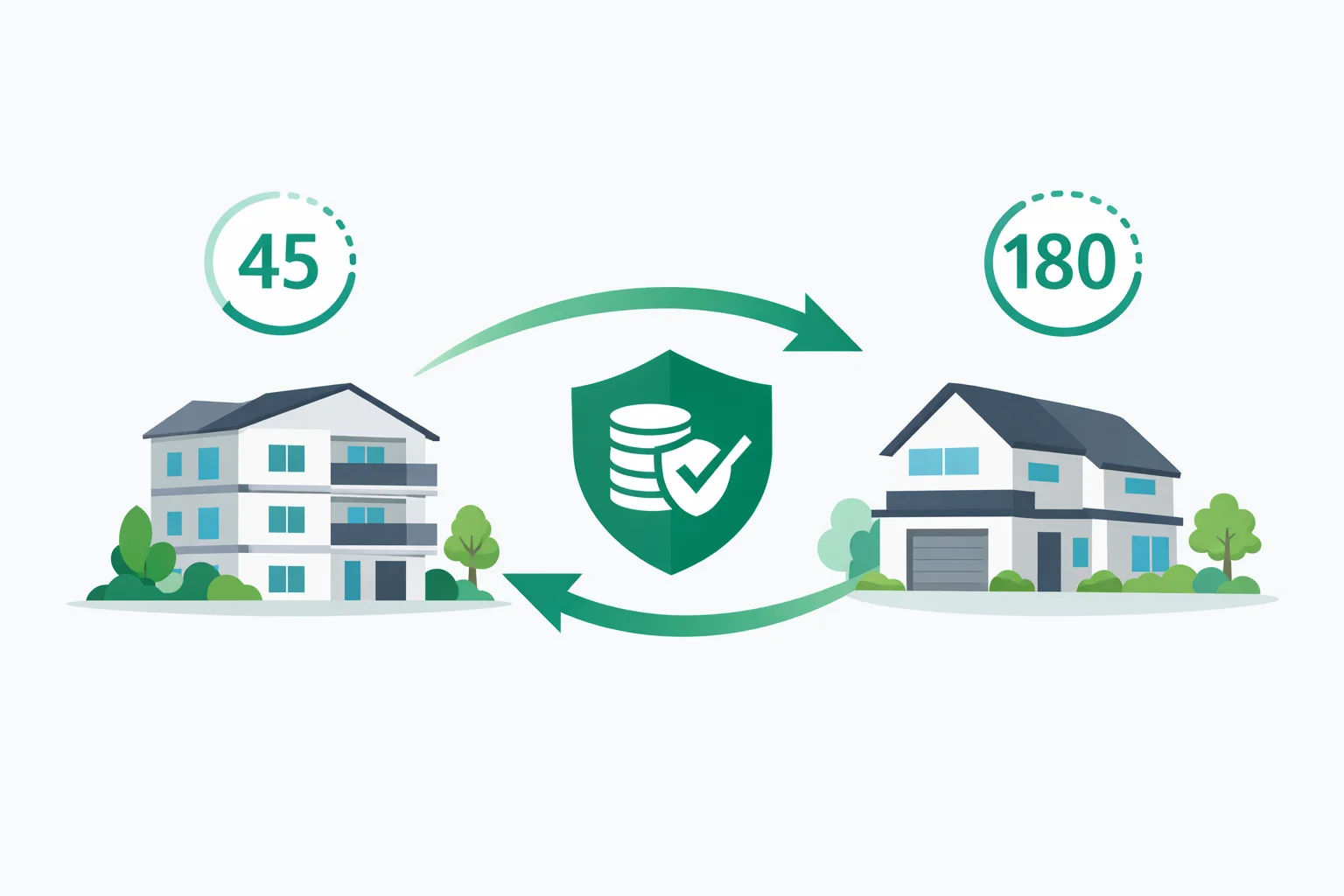
Full Tax Deferral
Defer 100% of capital gains and depreciation recapture when you reinvest in like-kind property
Strict Deadlines
45 days to identify and 180 days to close — miss either and you owe the full tax bill
Boot Trap
Any cash or debt reduction you pocket triggers partial tax — even $1 of boot is taxable
A 1031 exchange calculator shows you exactly how much capital gains tax you can defer by swapping one investment property for another instead of selling outright. Here's the scenario that makes this concrete: you bought a rental duplex for $500,000 a decade ago, it's now worth $750,000, and you're eyeing a small apartment complex for $900,000. Sell the duplex normally, and you're writing a check to the IRS for roughly $120,000-$150,000 between federal capital gains, depreciation recapture, NIIT, and state taxes. Execute a 1031 exchange, and that entire amount stays invested — compounding in your new property instead of disappearing into the tax system.
Section 1031 of the Internal Revenue Code has been a wealth-building engine for real estate investors since 1921. The 2017 Tax Cuts and Jobs Act narrowed it to real property only (no more exchanging aircraft or artwork), but for investment real estate, it's more relevant than ever. Let's break down the math, the rules, and the traps.
The Three Taxes You're Actually Deferring
Most investors think a 1031 exchange just defers capital gains tax. It actually defers three separate taxes, and the depreciation recapture piece is often the largest:
| Tax Type | Rate | Applied To | Example ($250K Gain) |
|---|---|---|---|
| Federal Long-Term Capital Gains | 0% / 15% / 20% | Appreciation above adjusted basis | $12,800 |
| Depreciation Recapture (Sec. 1250) | 25% (flat) | All depreciation claimed or allowed | $50,000 |
| Net Investment Income Tax (NIIT) | 3.8% | Total gain if AGI > $200K/$250K | $9,500 |
| State Capital Gains | 0%–13.3% | Total gain (varies by state) | $12,500 (at 5%) |
| Total Tax Liability | Combined effective rate: ~34% | $84,800 | |
That $200,000 in depreciation you claimed over 10 years? The IRS wants 25% of it back at sale. On a $550,000 basis depreciated over a decade, that's $200,000 × 25% = $50,000 just for depreciation recapture — often more than the capital gains tax itself. A 1031 exchange defers all of it.
How the Adjusted Basis Math Works — Step by Step
The adjusted basis determines your taxable gain. Getting this number wrong is the most common reason investors miscalculate their 1031 savings. Here's the exact calculation for a property purchased at $500,000 with $50,000 in improvements, held for 10 years:
Original Purchase Price $500,000
+ Capital Improvements $ 50,000
= Cost Basis $550,000
Annual Depreciation $550,000 ÷ 27.5 = $20,000/yr
× Years Owned × 10
= Accumulated Depreciation $200,000
Adjusted Basis = $550,000 − $200,000 = $350,000
If you sell for $750,000 with 6% selling costs ($45,000), your net sale price is $705,000. The realized gain is $705,000 − $350,000 = $355,000. That breaks into $155,000 in capital gains (appreciation above the original $550,000 basis) and $200,000 in depreciation recapture. Use our depreciation calculator to verify your accumulated depreciation across different methods.
What Qualifies as "Like-Kind" — It's Broader Than You Think
"Like-kind" doesn't mean identical. Under IRS rules, any real property held for investment or business use can be exchanged for any other real property held for the same purpose. A single-family rental can be exchanged for a strip mall, raw land for an apartment building, or a commercial warehouse for a vacation rental. The key restrictions:
- Must be investment or business property — your primary residence doesn't qualify (but a rental unit within a multi-family you live in might)
- Real property only since 2018 — personal property like equipment, vehicles, and intellectual property no longer qualifies
- Must be within the U.S. — domestic property for domestic property only; you can't exchange a Miami condo for a Cancún villa
- "Held for" test matters — properties flipped within months rarely qualify; the IRS looks for a holding period of at least 12-24 months
The Boot Trap: Where Most Exchanges Leak Tax
"Boot" is the technical term for any value you receive in the exchange that isn't like-kind property. It comes in two forms, and both are taxable:
Cash Boot
Pocket $50,000 from the exchange instead of reinvesting it? That $50,000 is taxable at your combined capital gains rate. On a $355,000 gain with a 28.8% combined rate, that's $14,400 in taxes.
Mortgage Boot
Old mortgage: $200,000. New mortgage: $150,000. The $50,000 difference is mortgage boot — taxable even though you didn't receive cash. New debt must equal or exceed old debt.
Here's the part that catches people: cash boot and mortgage boot offset each other. If your old mortgage was $200,000 and your new mortgage is $150,000 ($50,000 mortgage boot), you can eliminate the boot by adding $50,000 more cash to the exchange. But you can't do it the other way — more debt doesn't offset cash boot.
Sell vs. Exchange: A Side-by-Side Comparison
Let's run the full numbers on our $750,000 duplex scenario. Original purchase: $500,000. Improvements: $50,000. Held 10 years. Old mortgage: $200,000. Replacement property: $900,000 with a $400,000 mortgage. Selling costs: 6%.
| Line Item | Sell Outright | 1031 Exchange |
|---|---|---|
| Net Sale Price | $705,000 | $705,000 |
| Mortgage Payoff | −$200,000 | −$200,000 |
| Capital Gains Tax (20%) | −$31,000 | $0 |
| Depreciation Recapture (25%) | −$50,000 | $0 |
| NIIT (3.8%) | −$13,490 | $0 |
| State Tax (5%) | −$17,750 | $0 |
| Cash Available to Reinvest | $392,760 | $505,000 |
| Tax Deferred | — | $112,240 |
That $112,240 isn't just tax savings — it's additional investment capital. If the replacement property appreciates at 4% annually, that extra $112,240 generates roughly $4,490 per year in additional equity growth. Over another 10 years, the compounding effect adds over $53,000 to your net worth compared to selling and reinvesting after tax.
The 45/180 Day Rules — No Extensions, No Exceptions
The IRS deadlines for a delayed (forward) exchange are absolute. Congress has never granted a blanket extension — not during COVID, not during natural disasters, not ever for individual hardship.
45-Day Identification Window
You must identify up to 3 potential replacement properties in writing to your qualified intermediary. The "3-property rule" limits you to 3 regardless of value. The "200% rule" lets you identify more, but total fair market value can't exceed 200% of the relinquished property.
180-Day Closing Deadline
You must close on the replacement property within 180 calendar days of selling the relinquished property. If your tax return is due before day 180, you must file an extension — or the exchange fails on your filing date.
Costly Mistakes That Blow Up 1031 Exchanges
Touching the Proceeds — Cost: Entire Tax Deferral
If you receive even $1 of the sale proceeds directly, the exchange is disqualified. All funds must flow through a qualified intermediary (QI). You cannot use your attorney, title company, or real estate agent as QI if they've worked for you in the past 2 years.
Reducing Debt Without Adding Cash — Cost: $5,000-$50,000+
Old mortgage: $300,000. New mortgage: $200,000. That $100,000 in debt relief is mortgage boot, taxed at your combined rate. On $100K of boot at a 28.8% rate, you owe $28,800 — money you thought you'd deferred. Always match or exceed your old debt.
Missing the 45-Day Deadline by Even One Day — Cost: Entire Deferral
Day 46? Exchange disqualified. There is no "close enough" with the IRS. Calendar days, not business days. An investor selling on January 15 must identify by March 1 — not March 2, regardless of weekends or holidays.
Using the Property as a Primary Residence Too Soon — Cost: Partial or Full Disqualification
The IRS requires the replacement property to be held for investment. Moving in immediately signals personal use. Safe harbor: rent the property for at least 24 months (14+ days/year to tenants) before converting to personal use.
When a 1031 Exchange Gives You Wrong Answers
A 1031 exchange isn't always the right move. Here are specific situations where the math doesn't work:
Your gain is under $80,000 (married filing jointly) — if your total income keeps you in the 0% long-term capital gains bracket, you'd pay zero federal tax on the sale anyway. The exchange adds QI fees ($750-$2,500), complexity, and a lower basis on the replacement property for no tax benefit.
You're in a state with no income tax — in Texas, Florida, Nevada, or other no-income-tax states, the total tax rate drops significantly. If your gain is modest and your federal bracket is 15%, the $1,500+ QI fee and reduced basis may not be worth the deferral.
You need liquidity — a 1031 exchange locks 100% of equity into the replacement property. If you need cash for another investment, a business emergency, or portfolio diversification, taking the tax hit and freeing up capital may produce better risk-adjusted returns.
You plan to hold until death — heirs receive a stepped-up basis, eliminating all deferred gain permanently. But if you exchange into a property you'll sell again in 5 years, you're just delaying the inevitable (though the time value of the deferred tax still has value).
The Stepped-Up Basis Strategy: How 1031 Exchanges Become Permanent Tax Elimination
Here's the strategy sophisticated investors actually use: chain multiple 1031 exchanges throughout your lifetime, deferring hundreds of thousands in taxes across each swap. When you pass the final property to your heirs, they receive a stepped-up basis equal to fair market value at date of death. Every dollar of deferred gain vanishes permanently.
The math is striking. An investor who buys a $300,000 property in 2005, exchanges into a $600,000 property in 2015, then exchanges into a $1,200,000 property in 2025 has deferred roughly $200,000-$350,000 in cumulative taxes across both exchanges. If they pass the $1.2M property to heirs at death, those heirs inherit a $1.2M basis — zero tax on any prior gains. Use our capital gains tax calculator to see what selling at each stage would have cost.
QI Fees and Exchange Costs — What You'll Actually Pay
| Cost Item | Typical Range | Notes |
|---|---|---|
| Qualified Intermediary Fee | $750–$2,500 | Per exchange; higher for reverse exchanges |
| Reverse Exchange (EAT) Fees | $3,000–$10,000 | Exchange accommodation titleholder costs |
| Legal Review | $500–$2,000 | Attorney review of exchange documents |
| Additional Closing Costs | $0–$1,000 | Extra title/escrow fees for exchange structure |
| Total Typical Cost | $1,250–$5,500 | Forward exchange; $3,500–$15,000 for reverse |
On our $750,000 sale example with $112,240 in deferred taxes, even the most expensive QI at $2,500 represents a 44:1 return on cost. The exchange pays for itself 44 times over. Calculate the potential returns on your replacement property using our rental property calculator.
Decision Framework: Should You Do a 1031 Exchange?
Exchange if your combined tax rate exceeds 20%, you're buying a property of equal or greater value, you can meet the 45/180-day deadlines, and you don't need the cash. The breakeven is typically around $15,000-$20,000 in deferred tax — below that, QI fees and complexity eat into the benefit.
Sell outright if you're in the 0% capital gains bracket, need liquidity, want to exit real estate entirely, or can't find a suitable replacement property within 45 days. Also consider selling if the property has minimal appreciation and limited depreciation recapture — the tax bite may not justify the exchange constraints.
Consider partial exchange if you want some cash but still want to defer the majority. You'll pay tax on the boot but defer the rest. Example: on a $355,000 gain, taking $50,000 in boot triggers ~$14,400 in tax but defers $97,840 — still a strong net win.
The 1031 exchange is the single most powerful tax deferral tool available to real estate investors. But it rewards preparation and punishes procrastination. Start identifying replacement properties before you list the relinquished property, line up your QI early, and run the numbers through the calculator above to know exactly what you're deferring — and what happens if you take boot. For a broader view of your property's investment performance, pair this analysis with our cap rate calculatorto evaluate the replacement property's return potential.