Adjustable Rate Mortgage Explained: When the Gamble Pays Off
Initial Savings Are Real
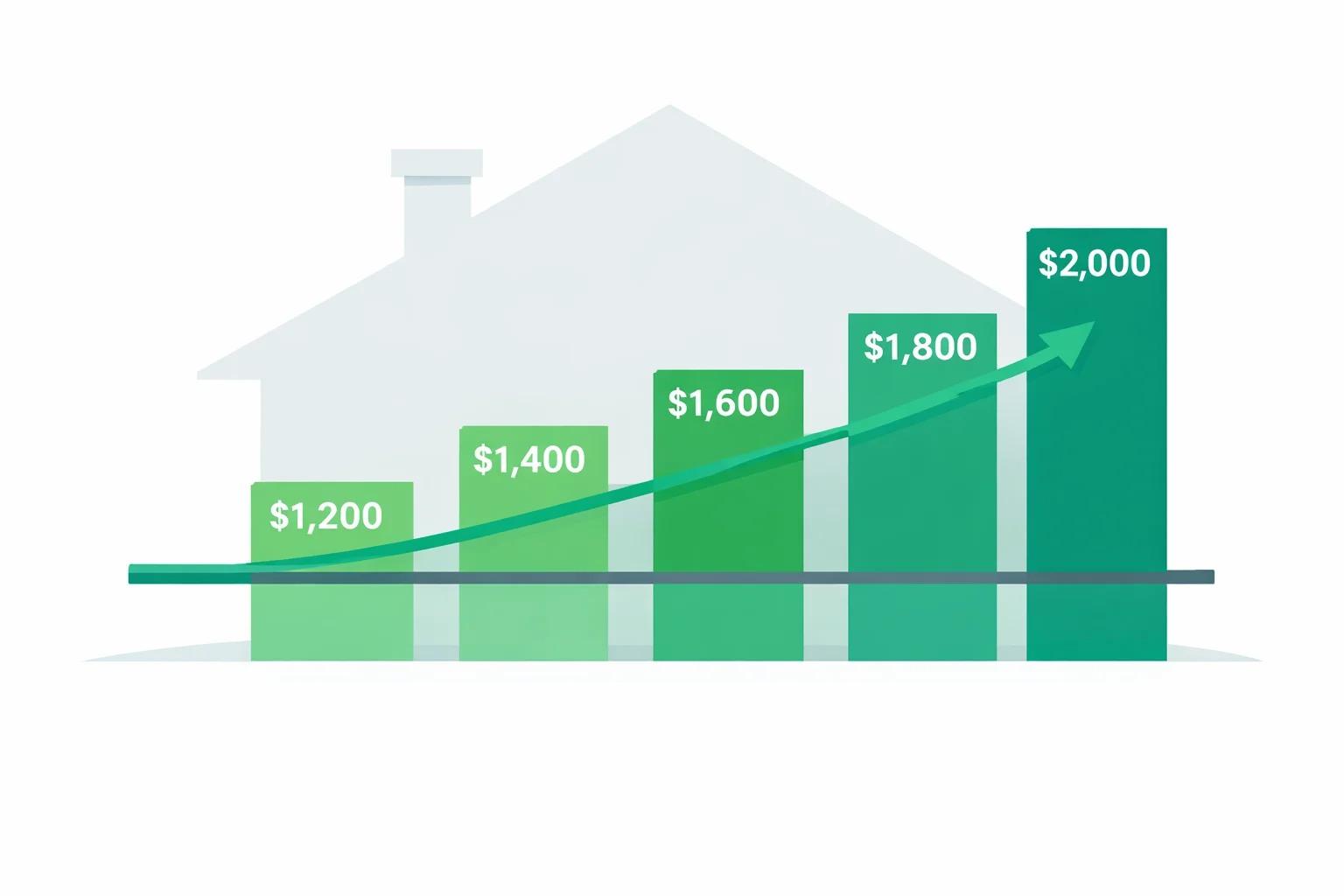
A 5/1 ARM at 5.75% vs 6.75% fixed on $400K saves $258/month — that's $15,480 over five years
Rate Caps Protect You
A typical 2/2/5 cap structure limits your rate to 10.75% max — even if market rates hit 15%
Timing Is Everything
80% of ARM borrowers refinance or sell before the first adjustment — the fixed period IS the loan for most
An ARM mortgage calculator answers the one question that keeps rate-shoppers up at night: "If I take the lower adjustable rate now, how much could my payment jump later — and is the savings worth the risk?" Here's the decision laid bare. On a $400,000 loan, a 5/1 ARM at 5.75% gives you a monthly payment of $2,334 versus $2,594 for a 30-year fixed at 6.75%. That's $260 less every month, $15,600 over the five-year fixed window. But after year five, your rate resets — potentially climbing as high as 10.75% with standard caps, pushing your payment above $3,400. Whether that trade-off makes sense depends on exactly three things: how long you plan to stay, how rates move, and how much payment shock you can absorb.
This isn't a simple "ARM bad, fixed good" decision. The National Association of Realtors reports that the median homeowner stays 13 years, but first-time buyers average just 6. If you're in that second group, you're paying a premium for 24 years of rate certainty you'll never use.
How ARM Rate Adjustments Actually Work
Every ARM has two phases. During the fixed period (the first number in "5/1"), your rate is locked — identical to a fixed-rate mortgage. After that, the rate adjusts annually (the "1") based on an index plus a margin.
New Rate = Index Rate + Margin
e.g., 4.25% (SOFR) + 2.75% (margin) = 7.00%
The index is a published benchmark — most ARMs today use the Secured Overnight Financing Rate (SOFR), which replaced LIBOR in 2023. The margin is fixed at origination, typically 2.50% to 3.00%. Your lender adds them together at each adjustment date to determine your new rate.
But here's what protects you: rate caps. A "2/2/5" cap structure means the rate can increase a maximum of 2% at the first adjustment, 2% at each subsequent adjustment, and 5% total over the life of the loan. On a 5.75% starting rate with 2/2/5 caps, your absolute worst case is 10.75% — even if SOFR spikes to 8%.
The Real Cost Difference: ARM vs Fixed Over 5, 10, and 30 Years
The right choice depends on your timeline. Here's the math on a $400,000 loan comparing a 5/1 ARM at 5.75% against a 30-year fixed at 6.75%, assuming the ARM rate increases 0.50% per year after the fixed period:
| Metric | 5/1 ARM (5.75%) | 30-Year Fixed (6.75%) | Difference |
|---|---|---|---|
| Initial Monthly Payment | $2,334 | $2,594 | -$260/mo |
| Total Paid (5 years) | $140,066 | $155,614 | ARM saves $15,548 |
| Total Paid (10 years) | $299,200 | $311,228 | ARM saves $12,028 |
| Total Paid (30 years) | $882,490 | $933,860 | ARM saves $51,370* |
| Year-6 Monthly Payment | $2,481 | $2,594 | ARM still $113 less |
| Worst-Case Payment (10.75%) | $3,430 | $2,594 | ARM $836 more |
*Assumes 0.50%/year rate increases and rates stay below lifetime cap. Actual savings depend on index movement.
The pattern is clear: if you sell or refinance your mortgage within the fixed period, the ARM wins every time. If rates climb steadily and you stay for 30 years, the ARM still wins in the expected scenario — but worst-case scenarios flip the advantage to fixed.
Which ARM Type Fits Your Situation?
| ARM Type | Fixed Period | Typical Rate Discount | Best For |
|---|---|---|---|
| 3/1 ARM | 3 years | 1.25-1.75% below fixed | Certain relocation within 2-3 years |
| 5/1 ARM | 5 years | 0.75-1.25% below fixed | First-time buyers, likely to move in 5-7 years |
| 7/1 ARM | 7 years | 0.50-0.75% below fixed | Moderate-term owners with refinance plans |
| 10/1 ARM | 10 years | 0.25-0.50% below fixed | Longer-term owners, near-fixed security with small discount |
The 5/1 ARM is by far the most popular, accounting for roughly 60% of all ARM originations according to Freddie Mac data. It hits the sweet spot: enough rate discount to deliver meaningful savings, enough fixed-period runway to cover most first-home ownership spans.
The Payment Shock Nobody Calculates
Mistake: Ignoring the first-adjustment jump
With a 2% initial cap, a $400K loan at 5.75% jumps from $2,334/month to $2,681/month at the first reset — a $347 increase overnight. That's $4,164 more per year. Budget for this before signing.
Mistake: Forgetting that escrow costs rise too
Your total housing payment includes property taxes and insurance, which increase independently. A $350 rate-driven payment jump combined with a $100 escrow increase means $450 more per month — not the $350 you planned for.
Mistake: Comparing ARM teaser rate to a fixed rate from a different lender
Always compare the ARM and fixed offers from the same lender on the same day. A 5.50% ARM from Lender A vs a 6.75% fixed from Lender B is not a fair comparison — Lender A's fixed rate might be 6.25%, shrinking the ARM advantage by 0.50%.
How Rate Caps Work — The 2/2/5 Structure Decoded
Rate caps are your safety net, and understanding them is non-negotiable before choosing an ARM. The three numbers represent three different protections:
- Initial cap (2%): The maximum your rate can increase at the first adjustment. Starting at 5.75%, your rate can't exceed 7.75% at the year-6 reset — regardless of where SOFR is.
- Periodic cap (2%): The maximum change at each subsequent annual adjustment. From 7.75% in year 6, you can't go above 9.75% in year 7.
- Lifetime cap (5%): The absolute ceiling over the life of the loan. At 5.75% + 5% = 10.75%, your rate is permanently capped — even if the index hits 12%.
Some lenders offer 5/2/5 caps (higher first adjustment) or even 2/1/5 caps (tighter periodic control). The tighter the caps, the higher the initial rate — lenders price the protection into the teaser. If you're comparing two ARMs, calculate the total interest cost under worst-case cap scenarios for each. A 5.50% ARM with 5/2/5 caps may cost more than a 5.75% ARM with 2/2/5 caps once rates rise.
Your ARM Decision in Three Questions
Choose ARM if all three are true:
- You plan to sell or refinance within the fixed period (3-10 years depending on ARM type)
- You can absorb a worst-case payment increase of 30-50% if plans change
- The initial rate discount is at least 0.75% below the comparable fixed rate
Choose Fixed if any one is true:
- You plan to stay for 10+ years and want budgeting certainty
- A 30-50% payment increase would strain your finances
- The ARM discount is under 0.50% — the savings don't justify the risk
- You're already stretching your debt-to-income ratio close to 43%
SOFR vs the Old LIBOR Index — What Changed in 2023
If you're comparing ARM terms, you'll see "SOFR-indexed" on nearly every new ARM. The Secured Overnight Financing Rate replaced LIBOR (London Interbank Offered Rate) as the standard benchmark after the LIBOR manipulation scandal. SOFR is based on actual overnight Treasury repo transactions — roughly $1 trillion in daily volume — making it harder to manipulate.
For borrowers, the practical difference is small. SOFR tends to run 0.10-0.30% below old LIBOR rates, so lenders increased margins accordingly. Your all-in rate (index + margin) ends up similar. The bigger change: SOFR is more volatile day-to-day but more stable over 30-day averages, which is the lookback period most ARM contracts use.
The Refinance Escape Hatch — And When It Fails
Most ARM borrowers plan to refinance before adjustments start. That strategy works beautifully — until it doesn't. Three scenarios where the escape hatch jams:
- Home value drops: If your home loses 10-15% of its value, you may not have enough equity for a conventional refinance (need 20% equity to avoid PMI). On a $400K home with 10% down, a 15% value decline puts you underwater.
- Income changes: Job loss, income reduction, or switching to self-employment can make you ineligible for a new mortgage just when you need one most.
- Rate environment spikes: If you're refinancing to escape a rising ARM rate but fixed rates have also jumped to 8-9%, you're just trading one high rate for another — and paying closing costs (typically 2-3% of the loan) to do it.
Before banking on the refinance plan, calculate the amortization scheduleto see how much equity you'll build during the fixed period. On a $400K loan at 5.75% over 5 years, you'll pay down roughly $36,000 in principal — combined with your down payment, that's your refinance buffer.
When an ARM Gives Misleading Results
The calculator shows expected outcomes based on your rate-increase assumptions. But assumptions aren't predictions. Here's when the numbers can mislead:
- Falling rate environments: If rates drop, your ARM rate falls too — the calculator's "expected increase" scenario overstates the cost. ARMs in declining-rate environments can outperform fixed rates by $40,000-$80,000 over 30 years.
- Short holding periods: If you sell in year 3 of a 5/1 ARM, the adjustment risk is zero. The calculator's 30-year projection is irrelevant — only the fixed-period savings matter.
- Negative amortization ARMs (rare today): Some older ARM products allowed payments below the interest-only amount, meaning your balance could grow. These are largely extinct post-2010 regulations, but if you see one, run.
The Hybrid Strategy: Invest the Savings
Here's an approach financial planners rarely mention. Take the $260/month you save with the ARM, invest it in a broad index fund averaging 8% annually, and you'll accumulate roughly $18,800 after 5 years. That investment cushion can offset 3-4 months of worst-case payment shock if rates spike at adjustment time.
Over 10 years — if rates rise moderately and you stay in the home — the invested savings can reach $46,000-$52,000, depending on market returns. That's not just offsetting the ARM risk; it's turning the rate discount into a wealth-building tool. Run the numbers through an investment calculator to model your specific scenario.
Current ARM Rate Benchmarks (2026 Reference)
| Product | Avg. Rate | Discount vs 30-Yr Fixed | Monthly Payment ($400K) |
|---|---|---|---|
| 30-Year Fixed | 6.75% | — | $2,594 |
| 5/1 ARM | 5.75% | -1.00% | $2,334 |
| 7/1 ARM | 6.00% | -0.75% | $2,398 |
| 10/1 ARM | 6.25% | -0.50% | $2,463 |
| 15-Year Fixed | 6.00% | -0.75% | $3,375 |
Rates shown are illustrative averages. Actual rates depend on credit score, LTV, and lender.
Bottom Line: The 5-Year Rule
If you're selling or refinancing within the fixed period, the ARM is almost always the better financial choice. The savings are guaranteed and the adjustment risk is zero. On a $400K loan, a 5/1 ARM at 1% below fixed saves $15,000-$16,000 over five years — real money that goes toward equity, investments, or reduced debt.
If you're staying long-term (10+ years) and sleeping well matters more than optimizing interest costs, the fixed rate buys peace of mind at a known premium. There's no wrong answer — only wrong assumptions. Run the numbers with your actual loan amount, actual rate quotes, and realistic rate-increase scenarios. The calculator above models all three — expected, worst-case, and best-case — so you can see the full range of outcomes before you commit.