How Biweekly Mortgage Payments Save You Thousands — and Cut Years Off Your Loan
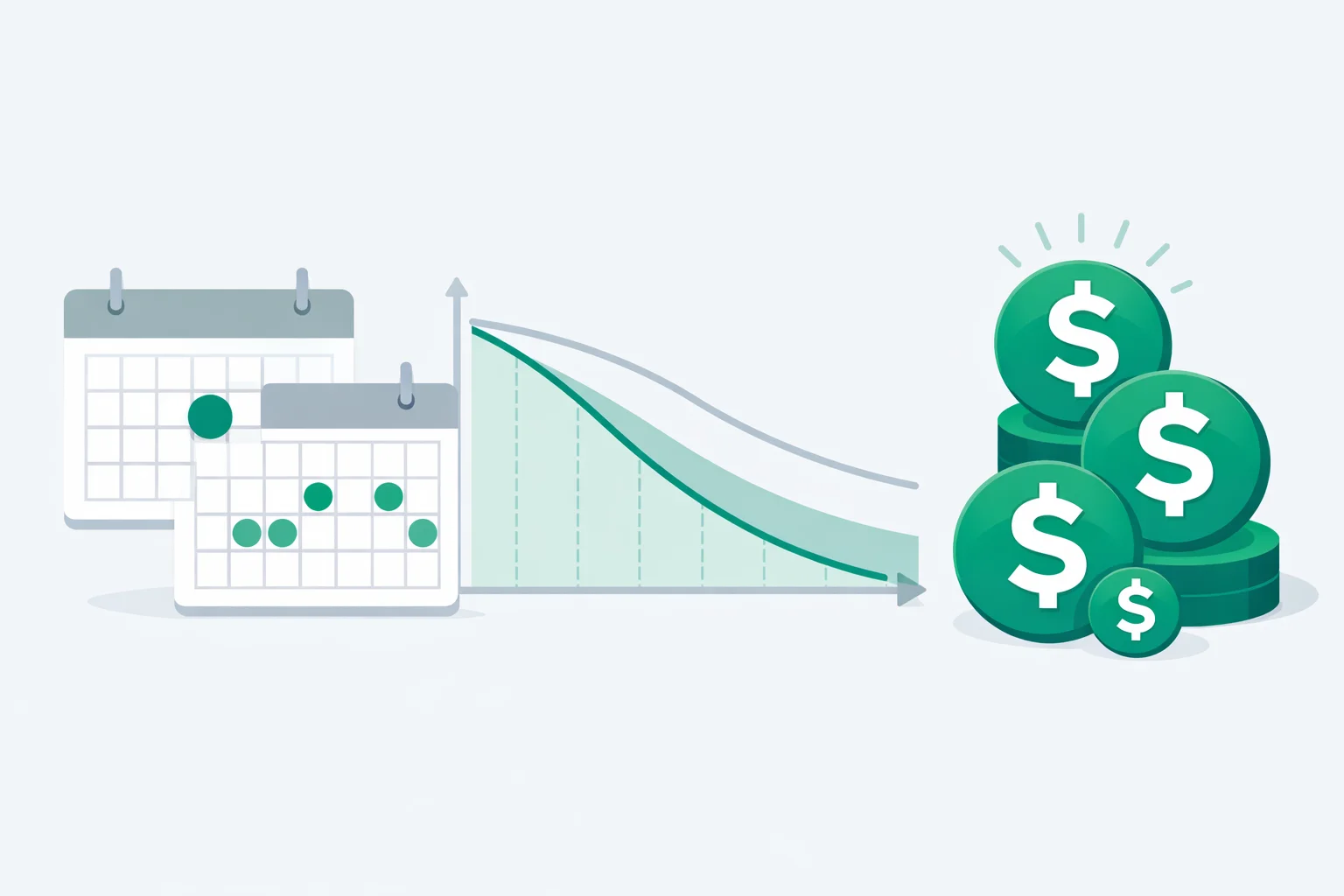
$62,000+ Savings
On a $350K mortgage at 6.75%, biweekly payments save over $62,000 in interest
4+ Years Faster
Pay off a 30-year mortgage in roughly 25 years with zero extra effort
No Extra Income Needed
You're not paying more each paycheck — the calendar does the work
A biweekly mortgage calculator shows you exactly how much interest and time you'll save by switching from 12 monthly payments to 26 biweekly payments each year. Here's the surprise most homeowners miss: on a $350,000 loan at 6.75%, this one switch saves over $62,000 in interest and knocks roughly 4.5 years off your mortgage — without increasing how much leaves your bank account each paycheck.
The trick is simple math. Twelve monthly payments equal 12 payments per year. Twenty-six biweekly payments equal 13 monthly equivalents. That one extra payment each year compounds over decades, and the results are dramatic.
How Biweekly Payments Work — The Math Behind the Savings
Your standard mortgage payment is calculated once per month. When you switch to biweekly, the lender (or a third-party servicer) takes exactly half your monthly payment every two weeks. Since there are 52 weeks in a year, that's 26 half-payments — the equivalent of 13 full monthly payments instead of 12.
Biweekly Payment Formula
Biweekly Payment = Monthly Payment ÷ 2
26 biweekly payments/year = 13 monthly equivalents/year
Worked example: Take a $350,000 mortgage at 6.75% over 30 years. Your monthly payment is $2,270.42. Under a biweekly plan, you pay $1,135.21 every two weeks. Over a full year, that totals $29,515.46 — compared to $27,245.04 with monthly payments. That extra $2,270 per year goes entirely toward principal, which reduces the balance faster, which means less interest accrues each period. The compounding effect accelerates over time.
Want to see the full month-by-month breakdown of your loan? Our mortgage amortization calculator shows exactly where every dollar goes across your entire loan term.
Key Factors That Determine Your Savings
Not all biweekly conversions save the same amount. These four variables make the biggest difference:
| Factor | Impact on Savings | Example |
|---|---|---|
| Interest Rate | Higher rates = bigger savings | At 7.5% you save ~$78K; at 5% you save ~$37K (on $350K) |
| Loan Amount | Larger loans = larger dollar savings | $500K at 6.75% saves ~$89K vs ~$36K on a $200K loan |
| Loan Term | Longer terms = more compounding time | 30-year saves 4.5 years; 15-year saves ~1.5 years |
| Extra Principal | Even $50 extra/biweekly dramatically accelerates payoff | $50 extra per biweekly payment saves an additional ~$30K |
The takeaway: if you're locked into a higher rate and can't refinance yet, biweekly payments are one of the most effective ways to fight back against that interest cost.
Biweekly vs. Monthly vs. Extra Payments — Which Strategy Wins?
Homeowners often ask whether they should go biweekly or just make one extra payment at year-end. The answer depends on your cash flow and discipline. Here's a comparison using a $350,000 loan at 6.75% for 30 years:
| Strategy | Total Interest | Interest Saved | Payoff Time |
|---|---|---|---|
| Standard Monthly | $467,351 | — | 30 years |
| Biweekly (half monthly) | $405,200 | $62,151 | ~25.5 years |
| Monthly + 1 extra/year (lump) | $410,800 | $56,551 | ~25.8 years |
| Biweekly + $50 extra | $372,400 | $94,951 | ~23.1 years |
Biweekly beats the annual lump-sum approach by about $5,600 because you're reducing principal throughout the year rather than waiting until December. Each biweekly payment chips away at the balance two weeks sooner, so less interest accrues in the next cycle.
If you're also evaluating whether to pay off your mortgage faster or invest the difference, our mortgage payoff calculator helps you model different extra payment amounts and see the exact payoff date.
Common Mistakes That Cost Homeowners Money
Paying a third-party biweekly service
Some companies charge $300-$400 setup fees plus monthly charges to manage biweekly payments for you. Most lenders offer this for free, or you can simply make one extra monthly payment per year yourself for the same effect. That $400 fee earns you nothing the calendar wouldn't.
Assuming your lender applies payments biweekly
Many servicers hold your biweekly payment in a suspense account until the full monthly amount arrives. This eliminates the interest-reduction benefit of paying earlier. Call your servicer and ask specifically: "Do you apply partial payments immediately to principal?" If they don't, you're just paying monthly with extra steps.
Forgetting about prepayment penalties
Some older mortgages and certain FHA or subprime loans carry prepayment penalties. On a $350K loan, this could be 2% of the balance — $7,000 — which would wipe out several years of biweekly savings. Check your loan documents before switching.
Prioritizing mortgage payoff over high-rate debt
If you're carrying credit card debt at 22% APR, the extra $190/month going toward your 6.75% mortgage is costing you money. Pay off high-interest debt first, then redirect that cash to biweekly mortgage payments.
The Real Reason Biweekly Payments Work So Well
Most explanations stop at "you make one extra payment per year." That's true, but it undersells what's actually happening. The real power comes from reducing the principal balance more frequently, which means each subsequent payment generates less interest.
With monthly payments, your balance sits unchanged for 30 days between payments. With biweekly, you're reducing it every 14 days. On a $350,000 balance at 6.75%, that two-week head start on each payment means roughly $33 less interest accrues before the next payment hits. Over 26 cycles, that's about $860 in additional interest savings per year — on top of the extra payment itself.
This frequency effect compounds. By year 10, your biweekly balance is roughly $20,000 lower than your monthly balance. By year 20, the gap is over $40,000. The savings accelerate precisely when it matters most — in the back half of the loan where interest-heavy payments dominate.
How to Set Up Biweekly Payments the Right Way
Call your loan servicer first. Ask if they offer free biweekly payment programs and whether they apply half-payments immediately or hold them. If they hold payments, skip their program.
DIY alternative: make 13 payments per year. Set up auto-pay for your normal monthly amount, then schedule one extra principal-only payment in a month you have three paychecks. You get 90% of the benefit with zero fees or setup hassle.
Align with your paycheck schedule. If you're paid biweekly, this is the easiest win in personal finance — set up automatic half-payments timed to each paycheck. You won't notice the difference in your checking account.
Label extra payments as "principal only." Any extra amount beyond your scheduled payment must be applied to principal, not next month's payment. Most servicer portals have a specific field for this.
Keep a one-month buffer in savings. Biweekly payments align with biweekly paychecks, but two months per year you'll have three payment dates. A $2,300 buffer prevents any overdraft surprises.
Biweekly Payments vs. Refinancing: A Decision Framework
Should you switch to biweekly payments, or refinance to a lower rate? It depends on the numbers and your timeline:
Choose biweekly payments when:
Your rate is already competitive (under 5%), you plan to stay 10+ years, you don't want to pay closing costs ($3,000-$8,000), or your credit score has dropped since you originated.
Choose refinancing when:
Rates have dropped 1%+ below your current rate, you'll break even on closing costs within 3 years, or you want to switch from a 30-year to a 15-year term. Then stack biweekly payments on top of the new lower rate for maximum savings.
Do both when:
You refinance to a lower rate AND switch to biweekly on the new loan. On a $350K refinance from 6.75% to 5.5% with biweekly payments, total savings exceed $150,000 compared to the original monthly plan.
Use our mortgage payment calculator to compare what your monthly payment would be at different rates and terms before deciding.
Reference Data: Biweekly Savings by Loan Size and Rate
This reference table shows approximate interest savings and time saved for common loan amounts and rates on a 30-year term:
| Loan Amount | At 5.5% | At 6.5% | At 7.5% |
|---|---|---|---|
| $200,000 | $24K saved / 4.2 yrs | $33K saved / 4.5 yrs | $44K saved / 4.8 yrs |
| $350,000 | $42K saved / 4.2 yrs | $58K saved / 4.5 yrs | $78K saved / 4.8 yrs |
| $500,000 | $60K saved / 4.2 yrs | $83K saved / 4.5 yrs | $111K saved / 4.8 yrs |
| $750,000 | $90K saved / 4.2 yrs | $124K saved / 4.5 yrs | $167K saved / 4.8 yrs |
When to Use This Calculator
- You just closed on a new home and want to set the optimal payment strategy from day one. Starting biweekly in year 1 captures the maximum savings.
- You're paid biweekly at work and want to align mortgage payments with your paycheck cycle. This is the lowest-friction way to accelerate your payoff.
- You're considering refinancing but rates haven't dropped enough. Biweekly payments give you meaningful savings without paying $5,000+ in closing costs.
- You have extra cash flow and want to compare the impact of different extra payment amounts. Even $25 extra per biweekly payment compounds significantly over 20+ years.
- You're planning early retirement and need to know exactly when your mortgage will be paid off. Use the biweekly schedule to target a specific payoff date that aligns with your retirement timeline.
If you're still shopping for the right loan or comparing different mortgage structures, our loan amortization calculator lets you build a full payment schedule for any loan type and term length.