Your Complete Guide to Calculating Car Payments
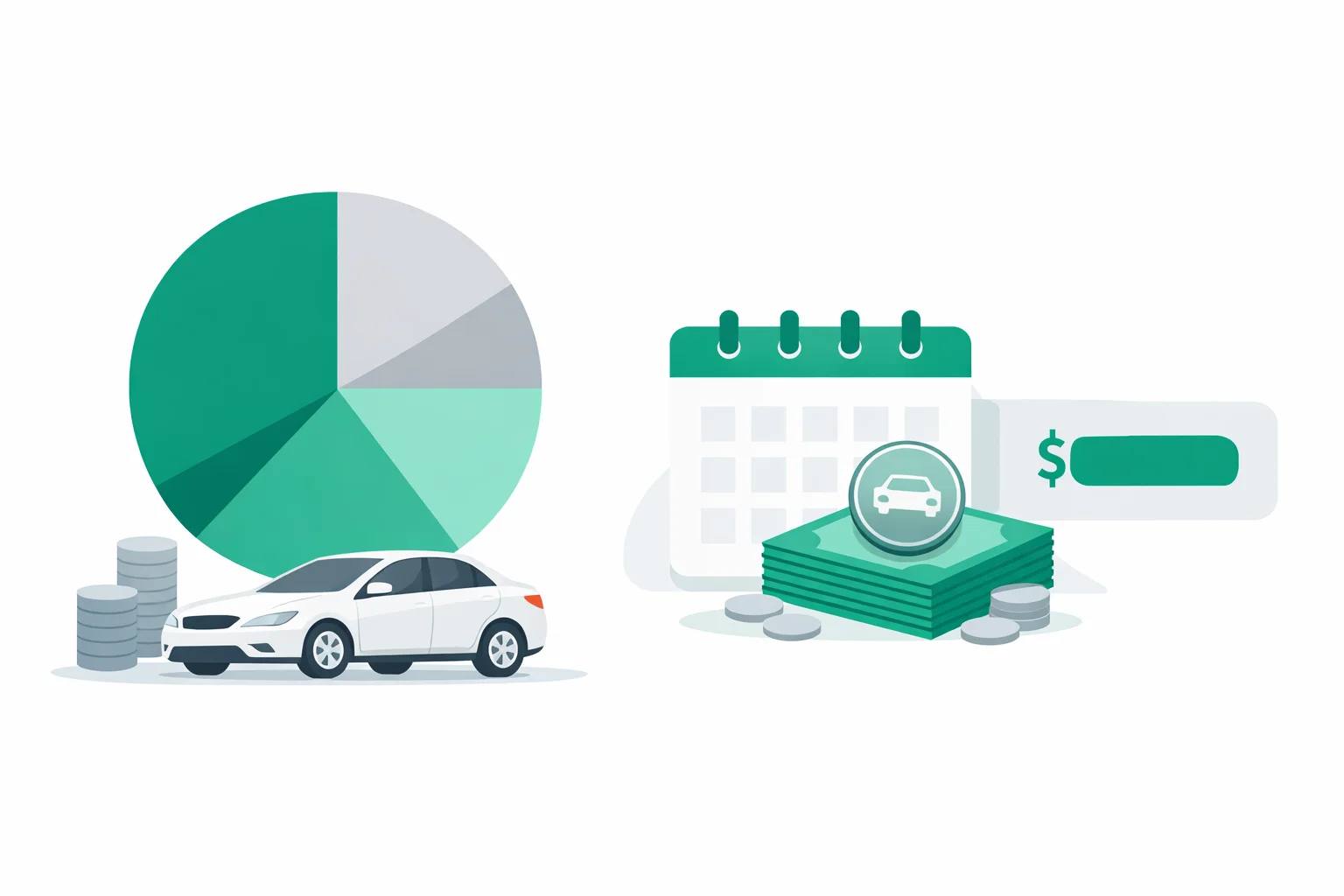
Average New Car Payment
$734/month in 2026 — up 22% from 2020. Knowing your payment before the dealership visit puts you in control.
Interest Adds Up Fast
At 6.89% APR on a $30,000 loan over 60 months, you will pay $5,586 in interest alone.
20/4/10 Rule
Put 20% down, finance for no more than 4 years, and keep total vehicle costs under 10% of gross income.
A car payment calculator estimates your monthly auto loan payment based on the vehicle price, down payment, interest rate, and loan term. With the average new car transaction price exceeding $48,000 in 2026, calculating your payment before visiting a dealership is the single most effective way to avoid overspending. This guide walks through the exact formula lenders use, shows you how each variable changes your payment, and provides worked examples so you can negotiate from a position of strength.
What Is a Car Payment?
A car payment is the fixed monthly amount you pay to a lender to repay an auto loan. Each payment splits into two parts: principal (paying down the balance) and interest(the lender's fee for lending you money). Early in the loan, most of your payment goes toward interest. By the final year, nearly all of it goes to principal. Understanding this split helps you see exactly where your money goes — and why a shorter loan term saves thousands in interest.
How Your Car Payment Is Calculated — The Formula
Lenders use the standard amortization formula to compute your monthly payment:
M = P × [r(1 + r)n] / [(1 + r)n − 1]
M = monthly payment
P = principal (amount financed)
r = monthly interest rate (annual rate ÷ 12)
n = total number of monthly payments
Worked example: You buy a $35,000 car with $5,000 down and a $3,000 trade-in. Sales tax at 7% applies to the net price ($27,000), adding $1,890. With $500 in title and registration fees, you finance $29,390. At 6.89% APR for 60 months:
r = 0.0689 / 12 = 0.005742
n = 60
M = $29,390 × [0.005742 × (1.005742)60] / [(1.005742)60 − 1]
M = $581.02 per month
Total interest paid: $5,471 | Total of all payments: $34,861
This is the same formula behind our calculator above, and it matches what every major lender — from Chase Auto to Capital One — uses for fixed-rate auto loans. For a deeper look at how loan amortization works, try our auto loan calculator which breaks down additional costs like gap insurance and extended warranties.
Key Factors That Affect Your Monthly Payment
Five variables determine what you pay each month. Adjusting even one can shift your payment by $50-200:
| Factor | Impact on $30,000 / 60-mo Loan | What You Can Control |
|---|---|---|
| Vehicle Price | Every $5,000 more = ~$99/mo increase | Negotiate below MSRP, consider certified pre-owned |
| Down Payment | $5,000 down saves ~$99/mo + $940 interest | Save for 20% down to avoid being upside-down |
| Interest Rate | 1% higher rate = +$14/mo, +$840 total interest | Improve credit score, get pre-approved, compare lenders |
| Loan Term | 72 vs 48 months: $183/mo less but $2,100 more interest | Shortest term you can afford saves the most |
| Trade-In Value | $5,000 trade-in credit = ~$99/mo savings | Get offers from Carvana, CarMax, KBB before the dealer |
Loan Term Comparison: 36 vs. 48 vs. 60 vs. 72 Months
Choosing the right loan term is the biggest decision after price. Here's how the same $30,000 loan at 6.89% APR compares across standard terms:
| Term | Monthly Payment | Total Interest | Total Paid |
|---|---|---|---|
| 36 months (3 yr) | $926 | $3,349 | $33,349 |
| 48 months (4 yr) | $717 | $4,418 | $34,418 |
| 60 months (5 yr) | $593 | $5,586 | $35,586 |
| 72 months (6 yr) | $510 | $6,750 | $36,750 |
The 72-month loan looks affordable at $510/month, but it costs $3,401 more in interest than the 36-month option. Worse, by month 36, you still owe roughly $16,200 on a car that may be worth only $14,000 — meaning you are upside-down on the loan. If your budget allows, a 48-month term is the sweet spot between manageable payments and reasonable total interest.
Common Car Payment Mistakes (and Their Cost)
Focusing Only on Monthly Payment
Dealers love stretching terms to 72-84 months to make numbers "work." On a $35,000 car, going from 48 to 84 months lowers your payment by $310/month but adds $5,200 in interest. Always ask: "What's the total cost of this loan?"
Skipping Pre-Approval
Walking into a dealership without a pre-approval letter means the dealer controls the rate. Average dealership markup on interest rates is 1-2%, costing $1,500-3,000 in extra interest on a typical loan. Get pre-approved by at least two lenders before shopping.
Ignoring Total Cost of Ownership
Your car payment is just one piece. Insurance on a $35,000 vehicle averages $1,800/year, maintenance runs $800-1,200/year, and depreciation averages 15-20% in year one. Use our auto loan payoff calculator to see how extra payments can reduce your total cost significantly.
Rolling Negative Equity Into a New Loan
If you owe $18,000 on a car worth $14,000, that $4,000 gap gets added to your next loan. On a $30,000 vehicle, you now finance $34,000 — starting $4,000 underwater on day one. This cycle compounds with each trade-in.
New vs. Used Car Financing: What to Expect
Interest rates differ significantly between new and used vehicles. Lenders charge more for used cars because they carry higher default risk and depreciate faster. Here is a realistic comparison:
| Scenario | New ($35,000) | Used 3-yr ($22,000) |
|---|---|---|
| Typical APR | 6.8% | 10.5% |
| Down Payment (20%) | $7,000 | $4,400 |
| Amount Financed | $28,000 | $17,600 |
| Monthly Payment (60 mo) | $554 | $378 |
| Total Interest | $5,217 | $5,076 |
| Total Paid (excl. down) | $33,217 | $22,676 |
Despite the higher rate, the used car costs $10,541 less in total payments because the principal is lower. For buyers on a budget, a 2-3 year old certified pre-owned vehicle often delivers the best value — lower price, similar reliability, and the steepest depreciation has already occurred.
How Your Credit Score Affects Your Rate
Your credit score is the single biggest factor in the rate you will receive. The difference between excellent and poor credit on a $30,000 auto loan is dramatic:
| Credit Score | Avg. New Car APR | Monthly Payment | Total Interest |
|---|---|---|---|
| 781-850 (Excellent) | 4.5% | $559 | $3,558 |
| 661-780 (Good) | 6.5% | $587 | $5,243 |
| 601-660 (Fair) | 9.5% | $631 | $7,839 |
| 501-600 (Poor) | 14.0% | $698 | $11,903 |
The difference between excellent and poor credit is $139/month and $8,345 in total interest. If your score is below 660, consider spending 3-6 months improving it before financing. Paying down credit card balances to under 30% utilization can boost your score 40-80 points. Check your rate potential with our auto loan APR calculator.
Smart Strategies to Lower Your Car Payment
Get Pre-Approved by 3+ Lenders
Credit unions typically offer 0.5-1.5% lower rates than banks. Multiple auto loan inquiries within 14 days count as a single hard pull on your credit report.
Make the Largest Down Payment You Can
Every $1,000 in down payment reduces your monthly payment by ~$20 and saves $100-200 in interest over the life of the loan. Aim for 20% minimum.
Negotiate the Out-the-Door Price, Not Monthly Payment
Dealers use monthly payment negotiation to hide markups and extend terms. Always negotiate the total purchase price first, then discuss financing separately.
Consider a 1-2 Year Old Certified Pre-Owned
A vehicle loses 20-30% of its value in the first two years. A $35,000 car becomes a $25,000 CPO with a manufacturer warranty — saving $10,000 while getting nearly the same vehicle.
Refinance After 12 Months of On-Time Payments
If your credit has improved or rates have dropped, refinancing can save 1-2% APR. On a $25,000 balance with 48 months remaining, dropping from 8% to 6% saves $1,100. Use our auto loan refinance calculator to see your potential savings.
When to Use This Calculator
Before Visiting a Dealership
Know your maximum affordable payment before a salesperson anchors you to a higher number. Set your budget ceiling and stick to it.
Comparing New vs. Used Options
Run both scenarios side by side. A used car at 10% APR may still cost less overall than a new car at 5% APR due to the price difference.
Evaluating Dealer Financing Offers
Plug in the dealer's quoted rate and compare it against your pre-approval. If the dealer offers 7.5% but your credit union offers 5.9%, you will save over $2,000.
Deciding on Loan Term Length
Use the term comparison feature to see exactly how much a longer loan costs you in total interest — and whether the lower payment is worth it.
The 20/4/10 Rule: Is Your Car Budget Realistic?
Financial advisors recommend the 20/4/10 rule as a guideline for responsible car buying:
- 20% down payment — prevents being upside-down on the loan from day one
- 4-year (48 month) maximum term — keeps interest costs low and avoids depreciation-versus-balance problems
- 10% of gross monthly income — total transportation costs (payment + insurance + fuel) should stay under this ceiling
For a household earning $75,000/year ($6,250/month), total car costs should stay under $625/month. If your payment alone is $550, you need to keep insurance, gas, and maintenance to $75/month — which is nearly impossible. This is why running the numbers before committing to a purchase price matters more than any negotiation tactic.
Pro Tip: Biweekly Payments
Instead of 12 monthly payments, make 26 biweekly half-payments per year. This equals one extra full payment annually, cutting a 60-month loan to about 54 months and saving $400-800 in interest. Ask your lender if they support biweekly billing, or simply make one extra payment per year toward principal.