Verified Tool

Down Payment Calculator: Free Home Down Payment Calculator

Free down payment calculator for 2025. Calculate home down payments, PMI costs, and compare loan options including FHA, VA, and conventional loans.

Down Payment Calculator

Calculate your upfront costs and monthly payments

$
$
%
%
$

Down Payment

$20,000
5.0% Equity

Loan Amount

$380,000
LTV: 95.0%

Est. Monthly PMI

$184
Until 20% equity reached

Total Monthly Payment

$3,341
Includes P&I, Tax, Ins, PMI

Loan Type Comparison (Minimums)

Loan TypeMin. DownMo. cost of PMI/MIPTotal Monthly
Conventional (3%)
$12,000$243$3,455
FHA (3.5%)
$14,000$177$3,376
VA (0%)
$0$0$3,297
USDA (0%)
$0$0$3,297
Jumbo (10%)
$40,000$120$3,137

Monthly Payment vs. Down Payment %

See how increasing your down payment affects your monthly obligation

At 5% Down$3,341
At 10% Down$3,137
At 20% Down (No PMI)$2,737

PMI Removal Timeline

With 5.0% down, you are likely paying PMI. If you make standard payments, you will reach 20% equity (the standard removal threshold) roughly when your loan balance drops below $320,000.

Auto-termination at 78% LTVRequest removal at 80% LTV

Wait to save 20%?

If home prices rise 5% annually, waiting 1 year for a $400k home costs you $20,000 in equity + rent paid.

Gift Funds Accepted

Conventional and FHA loans typically allow 100% of your down payment to come from family gifts.

How to Use Our Down Payment Calculator

Step 1: Enter Home Details

Input your target home price and your available down payment amount. The calculator automatically calculates your down payment percentage and shows loan scenarios for 3% to 25% down.

Step 2: Adjust Loan Terms

Set your expected interest rate (2025 average: 7-8%) and loan term. Most buyers choose 30-year terms for lower monthly payments, but 15-year terms save significant interest.

Step 3: Compare Loan Types

Review the loan comparison table showing minimum down payments for conventional (3%), FHA (3.5%), VA (0%), USDA (0%), and jumbo (20%) loans with estimated monthly costs.

Step 4: Analyze PMI Impact

If your down payment is under 20%, the calculator shows PMI costs and estimates when you'll reach 20% equity to eliminate PMI, potentially saving thousands annually.

Key Features of Our Calculator

Compare All Loan Types

Side-by-side comparison of conventional, FHA, VA, USDA, and jumbo loan down payment requirements and monthly costs to find your best option.

PMI Cost Calculator

Accurate PMI calculations based on down payment percentage. See exactly how much mortgage insurance costs and when you can eliminate it.

Visual Payment Breakdown

Interactive chart showing how monthly payments change with different down payment amounts, helping you optimize your down payment strategy.

State-Specific Insights

Median down payment data by state shows realistic expectations—ranging from $15,800 (Mississippi) to $820,000 (Hawaii) based on 2025 market data.

Equity Timeline Tracker

See exactly when you'll hit 20% equity to eliminate PMI, including strategies like extra payments to reach this milestone faster and save thousands.

Total Cost Analysis

Understand the true cost of different down payment scenarios, including interest over loan life, PMI costs, and opportunity cost analysis.

The 20% Down Payment Myth in 2025
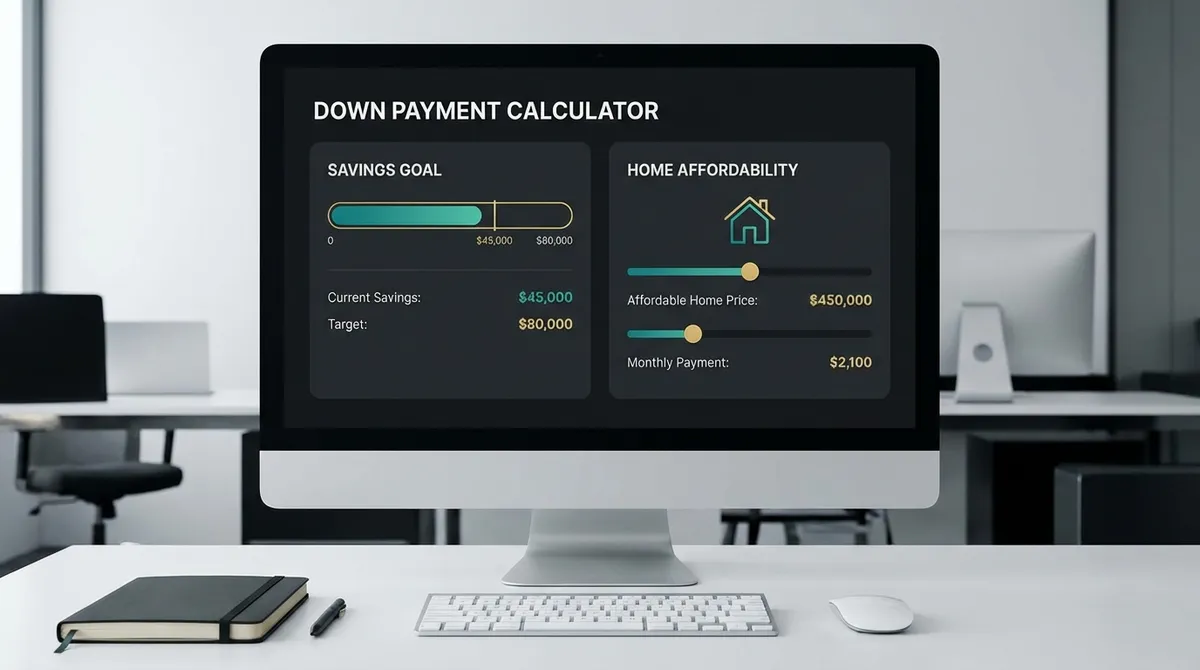
Down Payment Calculator — Free Home Down Payment Calculator & 2025 Guide

If you think you need 20% down to buy a home, you might be waiting years longer than necessary. This is one of the most pervasive myths in real estate. In 2025, the median down payment for first-time homebuyers is actually just 6-7%, and for repeat buyers, it hovers around 17%. The days of needing 20% cash upfront are long gone for most buyers.

While putting 20% down does avoid Private Mortgage Insurance (PMI) and lowers your monthly payment, waiting to save that massive lump sum often costs significantly more in lost home appreciation than the PMI itself. This comprehensive guide breaks down the real math behind down payments, how PMI actually works, and strategies to buy sooner with less cash upfront.

Did you know?

Qualified first-time buyers can purchase a home with as little as 3% down on a Conventional loan, or 3.5% on an FHA loan. Veterans and USDA-eligible rural buyers can often buy with 0% down.

Understanding the Numbers

Our calculator works alongside our home affordability calculator to help you find the "sweet spot" between your available cash and your monthly budget goals. It's crucial to understand how shifting your down payment affects your long-term costs.

Input Variables

  • Home Price: The negotiated purchase price of the property, not necessarily the listing price.
  • Down Payment: Cash paid upfront. This equity protects the lender and determines your Loan-to-Value (LTV) ratio.
  • Loan Term: Duration of the mortgage. 30-year fixed is standard, but 15-year terms offer lower rates.

Key Outputs

  • LTV Ratio: Loan-to-Value. Lenders use this to price risk. (e.g., $10k down on $200k = 95% LTV).
  • PMI Cost: Estimated monthly mortgage insurance. This drops off once you build enough equity.
  • Total Monthly: The real number you need to budget for—including Principal, Interest, Taxes, Insurance, and PMI.

Minimum Down Payments by Loan Type

Choosing the right loan program is the single biggest factor in your down payment requirement. Each program is designed for a specific buyer profile.

Loan ProgramMin. DownCredit ScoreBest For
Conventional 973%620+First-time buyers with good credit. PMI is removable and often cheaper than FHA.
FHA Loan3.5%580+Buyers with lower credit (down to 500 with 10% down) or higher debt ratios.
VA Loan0%N/A*Veterans & active military. Often the best loan available due to 0% down and no PMI.
USDA Loan0%640+Buyers in eligible rural/suburban areas with moderate income boundaries.
Jumbo Loan10-20%700+Luxury homes exceeding conforming loan limits. Requirements are stricter.

*VA loans don't have a strict minimum credit score set by the VA, but most private lenders look for 620+ as an "overlay".

The Truth About PMI (It's Not Evil)

Myth: "PMI is throwing money away."

Reality: PMI is the tool that allows you to buy a home years earlier than otherwise possible. It is the cost of leveraging the bank's money to secure an appreciating asset.

Think of PMI (Private Mortgage Insurance) as the "fee" for borrowing the down payment you haven't saved yet. Usually costing between 0.5% and 1.5% of the loan amount annually, it's often far cheaper than the cost of waiting.

The "Cost of Waiting" Analysis

Let's look at the math. Suppose you want to buy a $400,000 home. You have 5% ($20,000) saved. Historically, real estate appreciates about 4-5% per year.

Option A: Buy Now (5% Down)

  • Purchase Price: $400,000
  • Down Payment: $20,000
  • Monthly PMI: ~$150
  • 3 Years of PMI Cost: -$5,400
  • Equity Gained (5% growth): +$63,000
  • Net Win: +$57,600

Option B: Wait 3 Years

  • Future Price (5% growth): $463,000
  • New 20% Down Needed: $92,600
  • Monthly PMI: $0
  • Rent Paid ($1.5k/mo): -$54,000
  • Equity Gained: $0
  • Net Loss: Missed Opportunity

*This is a simplified example. Taxes, maintenance, and closing costs also factor in, but the opportunity cost of missed appreciation is often the dominant factor in rising markets.

Don't Forget Closing Costs!

A common tragedy in real estate is saving exactly 3.5% for an FHA down payment, only to realize you need another 3-5% for closing costs. Closing costs are separate from your down payment.

On a $400,000 home, closing costs typically run $8,000 to $15,000 depending on your state's tax laws. These pay for:

Origination FeesLender processing (0.5-1%)
AppraisalHome valuation ($500-$800)
Title Ins.Ownership protection (0.5-1%)
PrepaidsTaxes & Insurance upfront

Strategy: You can often negotiate for the seller to pay your closing costs (known as "Seller Concessions"). FHA allows sellers to contribute up to 6% of the sale price, while Conventional allows up to 3% (if putting less than 10% down).

How Down Payment Affects Your Rate

Your down payment doesn't just lower your loan amount; it lowers your risk profile. Lenders offer better interest rates to borrowers with more "skin in the game." This creates a double-saving effect:

  1. Direct Saving: You borrow less, so you pay interest on a smaller principal.
  2. Rate Saving: You get a lower rate, so you pay less interest on every remaining dollar.

Scenario: 740 Credit Score, $400k Home

3% Down7.125% RateHigher risk premium
5% Down6.990% RateRate drops 0.135%
20% Down6.750% RateRate drops 0.375%

*Rates are hypothetical examples for illustration. Actual adjustments (LLPAs) vary daily.

Buying an Investment Property?

Warning: The rules change completely if you won't live in the home. "Owner-occupied" loans (primary residence) get the cheap 3-5% down options. Investment properties (rentals) typically require 20-25% down to secure a conventional loan.

  • Single Family Rental: Usually 15% minimum, but 20-25% gets a much better rate.
  • 2-4 Unit Multi-Family (Living in one unit): This is the "House Hacking" loophole. You can use an FHA loan with 3.5% down to buy a 4-plex, live in one unit, and rent the other three.
  • Vacation Home: Usually requires 10% down minimum.

3 Proven Strategies to Boost Your Down Payment

Gift Funds

Family members can gift you 100% of the down payment for practically any loan type. A simple "gift letter" is all lenders require. This is the #1 way first-time buyers bridge the gap.

401(k) Leverage

First-time buyers can withdraw up to $10,000 penalty-free from IRAs. Better yet, many can take a loan against their 401(k) for up to $50,000, paying the interest back to themselves.

HFA Programs

State Housing Finance Agencies (HFAs) offer grants and "silent second" mortgages to cover down payments. These often have 0% interest and no monthly payments until you sell.

Deep Dive: Down Payment Assistance (DPA) Programs

Did you know there are over 2,500 DPA programs across the US? Many are state-specific, but they generally fall into three buckets:

  • 1
    Grants (Free Money)

    Funds that never have to be repaid. These are rare and usually income-restricted, often reserved for buying in "revitalization areas" or for specific professions like teachers/police (Good Neighbor Next Door).

  • 2
    Forgivable Loans (0% Interest)

    A second mortgage with 0% interest that is forgiven over time (e.g., 20% per year for 5 years). If you stay in the home for the full term, you pay nothing. If you move early, you repay the pro-rated balance.

  • 3
    Deferred Payment Loans

    A second mortgage that covers your down payment. You make no monthly payments on it, but you must repay the full amount when you sell the home or refinance. This is great for cash flow but reduces your net proceeds at sale.

Frequently Asked Questions About Down Payments

How much down payment do I need for a $400,000 house in 2025?

The minimum down payment depends on your loan type: Conventional loans require as little as 3% ($12,000) for qualified first-time buyers, FHA loans need 3.5% ($14,000), and VA/USDA loans offer 0% down ($0) for eligible buyers. However, you'll pay PMI with less than 20% down ($80,000), which typically costs $180-250/month until you reach 20% equity.

Is it better to put 20% down or just 5% in today's market?

In 2025's rising market, 5% down is often betterbecause home appreciation (5-8% annually) typically outpaces PMI costs. Buying sooner builds equity faster. The PMI on a 5% down payment averages $12,000-18,000 over 5-7 years, while waiting to save 20% could cost you $60,000-80,000 in missed appreciation. Plus, you can remove PMI once you hit 20% equity through payments and appreciation.

How long do I have to pay PMI with a low down payment?

PMI typically lasts until you reach 20% equityin your home. You can request removal at 80% loan-to-value (LTV), and lenders must automatically remove it at 78% LTV. For a 5% down payment, this usually takes 6-8 yearswith regular payments, or 4-5 years with extra principal payments. Home appreciation can accelerate this timeline significantly.

Can I use gift money for my entire down payment?

Yes, most loan programs allow 100% gift fundsfor down payments. Conventional loans require a gift letter documenting the relationship and confirming the money doesn't need to be repaid. FHA loans also allow 100% gifts from family members. However, some lenders may require you to contribute at least 5% from your own funds if your credit score is below 620. The gift must be properly documented with a gift letter and paper trail.

What credit score do I need for a 3% down conventional loan?

Conventional 97 loans (3% down) typically require a minimum credit score of 620-640. However, you'll get much better interest rates with scores above 680. For every 20-point increase in your credit score above 640, you can expect approximately 0.125% better interest rates. PMI rates are also credit-score based—a 740+ score can cut PMI costs by 30-40% compared to a 620 score.

Are there down payment assistance programs for repeat buyers?

Yes, many programs help repeat buyers too.While most DPA programs prioritize first-time buyers, "first-time" is defined as not owning a home in the past 3 years. So if you sold your previous home 3+ years ago, you may qualify as a "first-time buyer" again. Additionally, some programs specifically help displaced homemakers, single parents, or veterans regardless of previous homeownership. Check your state HFA for specific programs.

How do I calculate the total cost of waiting to save a bigger down payment?

Use our calculator to compare scenarios: Factor 5-8% annual home appreciation, current rent payments, and PMI costs. If homes appreciate at $24,000/year ($400,000 home at 6%), waiting 3 years to save an extra $40,000 costs you $72,000 in appreciation plus $36,000 in rent ($1,000/month)—totaling $108,000 lost, far exceeding PMI costs of $8,000-15,000 over that period.

Can I negotiate PMI rates with lenders?

Yes, PMI rates vary between lenders and you can shop around.PMI is provided by private insurance companies, and each lender has different arrangements. Get quotes from at least 3-4 lenders as rates can vary by 0.1-0.3 percentage points. You can also choose lender-paid PMI (LPMI) where the lender covers PMI in exchange for a slightly higher interest rate (typically 0.25-0.5% higher), which may be tax-deductible.

About the Author

Marko Šinko

Mortgage Expert & Financial Writer

Financial Writer, Mortgage Specialist

Marko Šinko is a mortgage expert and financial writer dedicated to helping homebuyers understand the complexities of financing their dream homes. He specializes in down payment strategies and loan comparisons.

Connect with Marko