The Investor's Guide to Debt Service Coverage Ratio (DSCR) in 2025
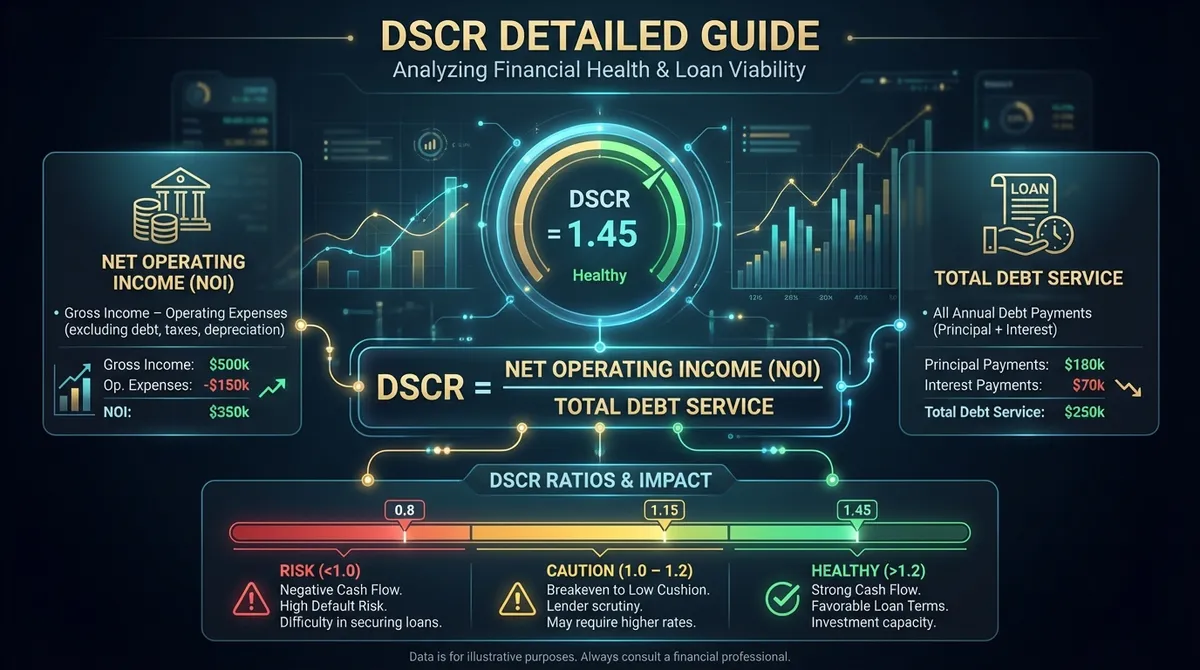
In the world of real estate investing, few numbers carry as much weight as the Debt Service Coverage Ratio (DSCR). It's the gatekeeper metric that lenders use to decide funding and investors use to measure safety.
Whether you are analyzing a single-family rental, a multifamily complex, or a commercial office building, understanding DSCR is non-negotiable. As we move deeper into 2025, lending standards have tightened. Loans guaranteed by the Small Business Administration (SBA) often have specific DSCR requirements. A strong DSCR not only qualifies you for loans but also shields your portfolio from cash flow crunches.
This guide will walk you through exactly what DSCR is, how to calculate it accurately (beyond the basic formula), and strategic ways to improve your ratio to unlock better financing terms.
What is the Debt Service Coverage Ratio?
The Debt Service Coverage Ratio (DSCR) measures a property's ability to generate enough cash flow to cover its debt obligations. It compares the property's Net Operating Income (NOI) to its total annual debt service (mortgage principal and interest).
A DSCR of 1.25x means the property generates $1.25 of income for every $1.00 of debt payment. It works alongside metrics like Cap Rate and Cash on Cash Return to give a complete picture of profitability.
Net Operating Income (NOI) Includes:
- • Rental Income (Gross)
- • Parking / Laundry Fees
- • Minus Vacancy Loss
- • Minus Operating Expenses (Taxes, Insurance, HOA, Maint, Mgmt)
Debt Service Includes:
- • Principal Payments
- • Interest Payments
- • Note: Taxes & Insurance are typically subtracted from NOI, not added to Debt Service in commercial analysis, but residential lenders often use PITIA. Our calculator supports both approaches via the expense inputs.
How to Interpret Your DSCR Result
Lenders use DSCR to assess risk. The higher the ratio, the lower the risk that you will default on the loan.
Negative Cash Flow. The property loses money every month. You must feed it cash from other sources to pay the mortgage. Most lenders reject this unless it's a "value-add" bridge loan.
Break-Even / Thin Margins. The property barely covers debt. One major repair or vacancy could cause default. Some aggressive lenders may approve, but rates will be higher.
Healthy Cash Flow. The industry standard for "safe" investments. Property covers debt plus a 25% cushion. Qualifies for the best interest rates and loan terms.
3 Strategies to Improve a Low DSCR
If your deal is analyzing at a 1.05x but you need a 1.25x to qualify for a loan, you have three main levers to pull:
1. Increase the Down Payment (Decrease Debt)
This is the most direct method. By borrowing less, your monthly principal and interest payments drop, which immediately boosts the DSCR. Moving from 20% down to 25% or 30% down can often solve a DSCR problem.
2. Dispute Property Taxes or Insurance
Operating expenses drag down your NOI. Shopping for cheaper landlord insurance or appealing a high tax assessment can lower your monthly outflows, increasing the numerator in the DSCR formula.
3. Buy Rate Buydowns
A lower interest rate reduces your monthly payment. You can sometimes pay "points" upfront to lower the rate permanently or temporarily, lowering the annual debt service and improving the ratio.
Frequently Asked Questions
What is a good DSCR for investment property in 2025?
In 2025, most lenders look for a DSCR of 1.25x or higher. This means the property's net income is 25% higher than its debt payments, providing a safety cushion. Some aggressive programs may accept 1.0x-1.15x for experienced investors or lower leverage deals.
How do I calculate DSCR for a rental property?
The formula is DSCR = Net Operating Income (NOI) ÷ Annual Debt Service. To find NOI, subtract all operating expenses (taxes, insurance, HOA, vacancy, maintenance, management) from gross rental income. Do not include the mortgage in the expense deduction; the mortgage is the 'Debt Service' part of the equation.
Does DSCR include property taxes and insurance?
Property taxes and insurance are handled in the Net Operating Income (NOI) calculation. They are subtracted from gross income to arrive at NOI. Alternatively, some residential lenders calculate it using coarse gross income divided by PITIA. Our calculator uses the professional commercial method (NOI / Debt) for maximum accuracy.
Can I get a DSCR loan with a 1.0 ratio?
Yes, but options are limited. A 1.0x ratio suggests the property breaks even. Lenders perceive this as high risk. You will likely face higher interest rates, require a larger down payment (30-35%), or need significant cash reserves to qualify.
How can I improve my property's DSCR?
To boost your DSCR, you must either increase income or decrease debt. Strategies include: increasing the down payment to lower the mortgage payment, protesting property tax assessments to lower expenses, or making improvements to justify higher market rents.
What is the difference between specific DSCR and global DSCR?
Specific DSCR looks at a single property's cash flow. Global DSCR looks at the borrower's entire financial picture, including personal income, other debts, and all investment properties. Portfolio lenders often require a Global DSCR of 1.25x+ across your holdings.
Is DSCR calculated using gross or net income?
DSCR uses Net Operating Income (NOI), not gross income. You must deduct all operating expenses (taxes, insurance, maintenance, management, vacancy) from the gross rent before dividing by the debt service. Using gross income will give you a falsely high ratio that lenders won't accept.
How does an Interest-Only loan affect DSCR?
Interest-only (IO) loans improve your DSCR significantly during the IO period because the monthly debt payment is lower (no principal). For example, a loan might have a 1.40x DSCR during the IO period but drop to 1.10x once amortization starts. Lenders often qualify you based on the amortizing payment to ensure long-term viability.
Can I use DSCR for a Short-Term Rental (Airbnb)?
Yes, many lenders offer DSCR loans for short-term rentals. They typically use data from AirDNA or a specialized appraisal (Form 1007 with STR addendum) to determine projected income. Because STR income is volatile, lenders may require a higher DSCR (e.g., 1.30x) or a 12-month history of operating similar properties.
How to Calculate DSCR: Step-by-Step
- Determine Gross Income: Sum up all annualized rental income and other revenue streams.
- Subtract Vacancy: Deduct a percentage (typically 5-10%) for potential vacancy losses.
- Subtract Operating Expenses: Deduct taxes, insurance, HOA, management, and maintenance costs to find the NOI.
- Calculate Annual Debt Service: Sum 12 months of mortgage principal and interest payments.
- Divide: Divide the Annual NOI by the Annual Debt Service. The result is your DSCR.
Real-World Case Studies: DSCR in Action
Seeing how the numbers play out in real scenarios can help clarify why lenders are so focused on this metric.
Scenario A: The "High Risk" Deal
- NOI: $20,000
- Debt Service: $20,000
- DSCR: 1.00x
Verdict: Most banks will reject this loan because there is $0 margin for error. If the HVAC breaks or a tenant leaves for a month, the borrower must pay out of pocket. Only hard money lenders might touch this, at very high rates.
Scenario B: The "Cash Cow"
- NOI: $30,000
- Debt Service: $20,000
- DSCR: 1.50x
Verdict: Lenders love this deal. The property earns 50% more than the mortgage cost. The borrower will likely qualify for the lowest possible interest rate, lowest fees, and maximum loan-to-value (LTV).
DSCR Loan Documentation Checklist
While DSCR loans are "low doc" compared to conventional loans (no W-2s, no tax returns), you still need to provide a solid package to get approved.
Property Documents (The "Core")
- Appraisal with 1007 Rent Schedule: The most critical document. It proves the market value and the market rent.
- Lease Agreements: If the property is occupied, current signed leases are required.
- Proof of Rent Receipt: 2 months of bank statements showing rent deposits (to validate lease).
- Insurance Declaration: Proof of hazard/flood insurance coverage.
- HOA Statement: If applicable, showing monthly dues are current.
Borrower Documents (Entity & Liquidity)
- LLC Operating Agreement: Most investors close in an LLC. Lenders need the Articles of Organization and Operating Agreement.
- EIN Letter: IRS confirmation of your Tax ID.
- Bank Statements (2 Months): To prove you have the down payment + closing costs + 3-6 months of reserves.
- Credit Report: Authorization for a hard pull (Tri-merge).
- Track Record (Optional): A "Schedule of Real Estate Owned" showing your portfolio can unlock better "experienced investor" tiers.