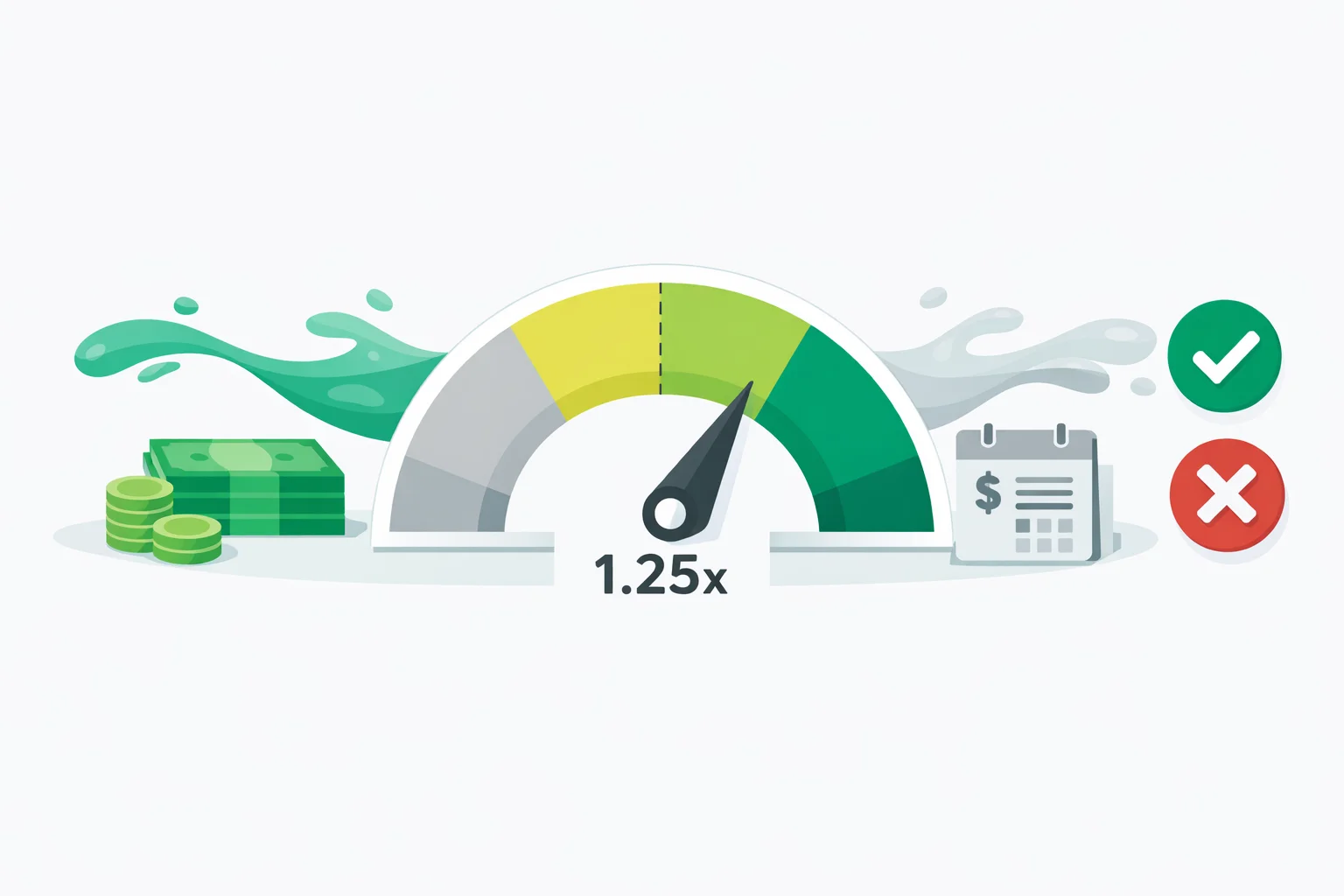
DSCR: The One Number a Loan Officer Checks Before Anything Else
A DSCR calculator answers the single question every business lender asks first: does your cash flow actually cover the loan you want? You apply for a $300,000 term loan, your banker pulls your tax returns, and within minutes they have a ratio in their head. If it lands below 1.25, the conversation about rates and terms barely happens. This page shows you that number before the bank does — and, just as important, the exact loan size your income will support.
The debt service coverage ratio compares the cash a business produces against the debt payments it owes. A 1.45x DSCR means you generate $1.45 of cash for every $1.00 of annual principal and interest. Lenders treat that $0.45 cushion as their safety margin. Run out of cushion and you're a higher default risk, which is why the ratio drives approval, pricing, and how much you can borrow.
1.25x is the line
Most banks decline conventional loans under 1.25x DSCR. SBA 7(a) accepts 1.15x.
Add-backs matter
Depreciation and owner salary get added back — they can lift DSCR by 0.2x or more.
Existing debt counts
Lenders measure the new loan plus every loan and lease you already carry.
The Formula Banks Actually Use
DSCR is simple division, but the inputs trip people up. The version commercial lenders use for business loans is:
"Adjusted" is the key word. Underwriters start with net operating income or EBITDA, then add back non-cash and owner-discretionary expenses because those dollars are still available to service debt. "Total debt service" is annual — it includes the new loan you're requesting and the principal-plus-interest on everything you already owe.
A Worked Example: The $300,000 Equipment Loan
Meet a fabrication shop applying for a $300,000 equipment loan at 8.5% over 10 years. Here's how the underwriter builds the ratio step by step:
- Start with NOI: The business clears $250,000 in net operating income.
- Add back non-cash items: $25,000 depreciation + $10,000 in one-time legal fees = $35,000 in add-backs. Adjusted NOI is now $285,000.
- Price the new loan: $300,000 at 8.5% over 10 years amortizes to about $3,720/month, or roughly $44,600 per year.
- Add existing debt: The shop already pays $38,000/year on a delivery van and a credit line. Total debt service = $44,600 + $38,000 = $82,600.
- Divide: $285,000 ÷ $82,600 = 3.45x DSCR.
At 3.45x, this loan sails through. But notice how each piece moved the needle. Forget the $35,000 in add-backs and the ratio drops to 3.02x — still fine here, but on a thinner deal that gap is the difference between approval and decline. The business loan calculator can show you the monthly payment for any amount, rate, and term so you can feed an accurate debt service figure into your DSCR.
How Lenders Read Your Ratio
There is no single magic number — the threshold depends on the loan type and how the lender prices risk. This table reflects the minimums most U.S. banks and SBA lenders apply:
| DSCR range | What it signals | Typical outcome |
|---|---|---|
| Below 1.00x | Income can't cover debt | Declined |
| 1.00x – 1.14x | Break-even, no cushion | Rarely approved |
| 1.15x – 1.24x | Meets SBA floor | SBA 7(a) possible |
| 1.25x – 1.49x | Comfortable margin | Standard approval |
| 1.50x and up | Strong coverage | Best rates & terms |
Sitting at 1.18x and targeting a conventional bank loan? You're short. Either restructure toward an SBA loan, which tolerates 1.15x, or extend the term to shrink the annual payment. A 10-year amortization instead of 7 on that $300,000 loan cuts the yearly payment by roughly $7,000 — often enough to push a borderline ratio over the line.
Add-Backs: The Lever Most Borrowers Underuse
Add-backs are legitimate expenses that reduce your stated profit but don't actually drain cash available for debt. Miss them and you understate your own DSCR. The usual suspects:
- Depreciation & amortization: Non-cash by definition. A business with $40,000 in annual depreciation adds it straight back.
- Owner's compensation above market: If the owner pays themselves $200,000 but a hired manager would cost $90,000, lenders often add back the $110,000 difference.
- One-time expenses: A lawsuit settlement, a move, or a system migration that won't recur.
- Interest on debt being refinanced: If the new loan pays off old debt, the old interest comes out of the expense base.
On a $250,000 NOI business, $50,000 of legitimate add-backs raises adjusted income to $300,000 — a 20% jump that flows straight into the ratio. Document every add-back with tax returns or a CPA letter; lenders disallow what they can't verify.
Global vs Business DSCR — Know Which One You're Being Judged On
For small businesses and single-owner companies, many lenders calculate a global DSCRthat blends business cash flow with the owner's personal finances. They add the owner's outside income and subtract personal debt like a mortgage and car payments. A business that posts a healthy 1.6x on its own can drop below 1.25x globally if the owner carries a heavy personal mortgage. If you're a sole proprietor or guarantor, ask which version your lender uses — and tidy up personal debt before applying. Reviewing your debt-to-equity ratio alongside DSCR gives lenders the full leverage picture they underwrite against.
Common Mistakes That Sink Applications
Using net income instead of NOI. Net income is after interest and taxes. Start there and you double-count interest, understating DSCR by 0.3x or more on a leveraged business.
Forgetting existing debt. A 1.6x ratio on the new loan alone can collapse to 1.1x once the $38,000/year you already owe is stacked on top.
Counting interest only. Debt service is principal and interest. On a 10-year amortizing loan, principal is the bigger half — leave it out and your real ratio is far lower than you think.
When NOT to Lean on This Calculator
DSCR assumes stable, recurring cash flow. It misleads in a few situations. Pre-revenue startups have no operating income to divide, so lenders look at projections and collateral instead. Highly seasonal businesses can show a fine annual DSCR while running cash-negative for four months — lenders stress-test monthly coverage there. And for rental or investment property, use the property-level DSCR calculator for real estate, which works from net operating income, vacancy, and the loan on a single property rather than a whole business. To pressure-test seasonality, model the inflows and outflows with a cash flow calculator before you assume an annual ratio tells the whole story.
How to Strengthen a Weak Ratio
Extend the amortization. Going from 7 to 10 years on a $300,000 loan trims roughly $7,000 off annual debt service.
Pay down or consolidate existing debt before applying — every $10,000/year of payments you remove lifts coverage.
Capture every add-back with documentation; $50,000 in depreciation and owner adjustments can move DSCR 0.2x.
Borrow less. Dropping the request from $300,000 to $230,000 cuts the annual payment by about $10,400.
When to Run These Numbers
- Before you formally apply — so a surprise decline doesn't ding your credit for nothing.
- When sizing a loan request: use the "max loan at target DSCR" figure to ask for an amount you'll actually get.
- When comparing an SBA 7(a) at 1.15x against a conventional loan at 1.25x to see which structure you clear.
- After adding new debt, to confirm you're not quietly drifting toward a covenant breach.
Plug in your real numbers above, watch where the gauge lands against the 1.25x line, and use the maximum-loan figure to walk into the bank asking for a number that already pencils. The best loan application is the one where the lender's math matches yours.