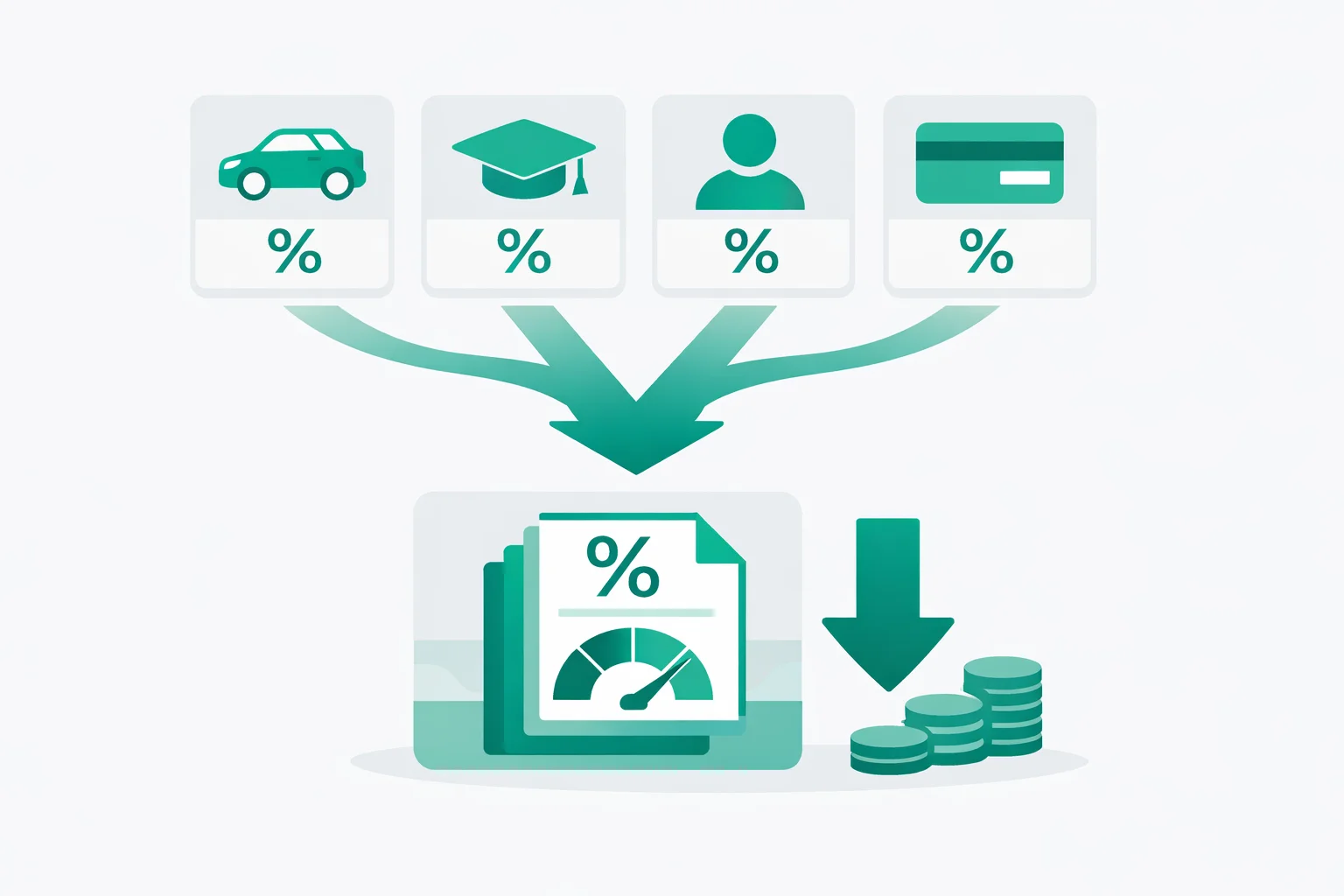
How a Loan Consolidation Calculator Finds Your Real Blended Rate
A loan consolidation calculator answers one question your individual loan statements never will: what is the true cost of carrying four or five debts at once, and would replacing them with a single loan actually save you money? You can't eyeball that. An auto loan at 7.5%, a student loan at 6.8%, a personal loan at 13.5%, and a credit card at 22.9% don't average out to anything you can guess — and the lender quoting you a "low" consolidation rate is hoping you never run the math.
One payment, one date
Combine five due dates into one. Fewer chances to miss a payment and trigger a 5%+ late fee.
Beat your blended rate
Savings only happen when the new APR clears your weighted-average rate — not your highest rate.
Watch the term
A lower monthly payment can hide thousands in extra interest if you stretch the loan out.
Your blended rate is the number that actually matters
When you carry several loans, the only interest rate that describes your real situation is the weighted-average APR— your blended rate. It's not the simple average of your rates; it's each rate weighted by how much you owe on it. The formula is:
Say you owe $18,000 at 7.5%, $24,000 at 6.8%, $9,000 at 13.5%, and $6,500 at 22.9%. Multiply each balance by its rate, add them up ($135,000 + $163,200 + $121,500 + $148,850 = $568,550), then divide by your $57,500 total balance. Your blended rate is 9.89%— not the 12.7% you'd get by averaging the four rates, and a long way from the scary 22.9% on the card. That single number is the bar any consolidation offer has to clear. This is exactly what the calculator above computes the instant you enter your loans.
The break-even rule: when consolidation genuinely saves money
Consolidation only cuts your interest cost when two conditions are both true: the new APR is below your blended rate, andthe new term isn't dramatically longer than your current payoff timeline. Miss either one and the deal works against you. A 7.99% loan beats a 9.89% blended rate — good. But if your current loans would clear in four years and you refinance them into a seven-year loan, you can pay more total interest even at the lower rate, simply because you're borrowing for longer. Rate and time both drive cost. The calculator weighs them together so you see the lifetime number, not just the monthly one.
The term-extension trap nobody warns you about
Here's the move lenders love: they advertise the lower monthly payment, not the total cost. Take a $58,000 consolidation loan at a fixed 7.99% APR and watch what the repayment term does to your interest:
| Term | Monthly Payment | Total Interest | vs. 3-Year Cost |
|---|---|---|---|
| 36 months | $1,817 | ~$7,400 | — |
| 48 months | $1,416 | ~$9,950 | +$2,550 |
| 60 months | $1,176 | ~$12,550 | +$5,150 |
| 72 months | $1,016 | ~$15,200 | +$7,800 |
| 84 months | $904 | ~$17,900 | +$10,500 |
Same loan, same rate. Dropping from a 36-month to an 84-month term cuts your payment by more than half — from $1,817 to $904 — but more than doubles your interest, from about $7,400 to nearly $17,900. That extra $10,500 is the price of "affordable." If cash flow is tight, a longer term can still be the right call, but run our debt payoff calculator to see whether adding even $50–$100 a month to a shorter term gets you to the same payment relief without the interest bill.
What origination fees really cost you
Most consolidation and personal loanscarry an origination fee of 1% to 8%, usually rolled into the loan balance. On a $57,500 consolidation, a 5% fee adds $2,875 to what you owe before you make a single payment. Whether the loan still makes sense comes down to a break-even calculation: divide the fee by your monthly savings. If consolidating saves you $115 a month and the fee is $1,150, you break even at month 10 — everything after that is real savings. If the fee is $2,875 and you only save $60 a month, you don't break even for 48 months, which can wipe out the benefit entirely on a short loan. The calculator shows this break-even point directly.
A full worked example: four loans into one
Let's run the four loans from earlier — $57,500 total at a 9.89% blended rate, with current payments of $1,290 a month. The longest of those debts (the student loan) wouldn't be paid off for nearly nine years, and across all four you'd pay roughly $16,300 in interest. Now consolidate into a single 60-month loan at 7.99% with a 1% origination fee:
| Metric | Keep 4 Loans | Consolidate |
|---|---|---|
| Interest rate | 9.89% blended | 7.99% |
| Monthly payment | $1,290 | $1,177 |
| Total interest | ~$16,300 | ~$12,570 (+ $575 fee) |
| Time to debt-free | ~8.9 years | 5 years |
| Net result | Save ~$3,200, pay $113 less per month, debt-free ~4 years sooner | |
This is the rare case where everything lines up: lower rate, lower payment, shorter overall timeline, and a small fee that the savings repay in roughly five months. Change the term to 84 months and that $3,200 of savings flips into a loss — proof that the term toggle matters as much as the rate.
When loan consolidation is the wrong move
Consolidation isn't a default-good decision. Skip it — or look elsewhere — in these situations:
- Your loans are nearly paid off.If most of your balances clear within 12–18 months, refinancing resets the clock and you'll likely pay more in fees and fresh interest than you save.
- The best rate you can get exceeds your blended rate.With fair or rebuilding credit, a consolidation offer of 14–18% won't beat a 9.89% blend. You'd be refinancing up.
- You'd give up federal student loan protections. Rolling federal loans into a private consolidation loan kills income-driven repayment, deferment, and forgiveness options that are often worth more than a 1–2% rate cut.
- The real problem is spending. If new credit-card balances reappear within months, consolidation just frees up the cards to be maxed again — leaving you with the new loan plus the old debt.
Mistakes that quietly cost you thousands
Comparing the new rate to your highest rate. Beating a 22.9% card feels like a win, but if that card is only $6,500 of a $57,500 blend, the rate to beat is 9.89%, not 22.9%.
Ignoring the origination fee. An 8% fee on a $40,000 loan is $3,200 — enough to erase the savings on a loan you planned to pay off in two years.
Choosing the longest term for the lowest payment. Going from 48 to 84 months on a $58,000 loan can add $8,000+ in interest while saving you barely $500 a month.
Secured vs. unsecured: the trade-off that changes everything
The cheapest consolidation rates almost always come from secured loans — a home equity loan or cash-out refinance — because your house backs the debt. That can mean a 7% rate instead of 12%, but it converts unsecured debt (where the worst case is a hit to your credit) into secured debt (where the worst case is foreclosure). Before you trade a credit-score risk for a roof-over-your-head risk, compare the all-in numbers against an unsecured option in our debt consolidation calculator, which models personal loans, balance transfers, and home equity side by side. For a deeper look at how the consolidation payment itself amortizes, the loan calculator breaks down principal versus interest month by month. And if you want the official rundown on consolidation versus counseling, the Consumer Financial Protection Bureau explains your options in plain language.
The one rule that keeps you honest
Don't judge a consolidation offer by the monthly payment. Compare the lifetime cost— total interest plus fees — against keeping your current loans. If the consolidated number is lower and you won't reload the debt you just cleared, consolidate. If it's higher, the lower payment is an illusion you'll pay for later.
Next step:enter your actual loan balances, rates, and payments above, then nudge the new APR and term until the lifetime-cost line beats "keep current loans." That's your real target rate to shop for.
Figures are estimates for illustration. Confirm rates, fees, and terms with your lender before deciding.