The Subscription Audit: What Eight Recurring Charges Really Cost Over a Decade
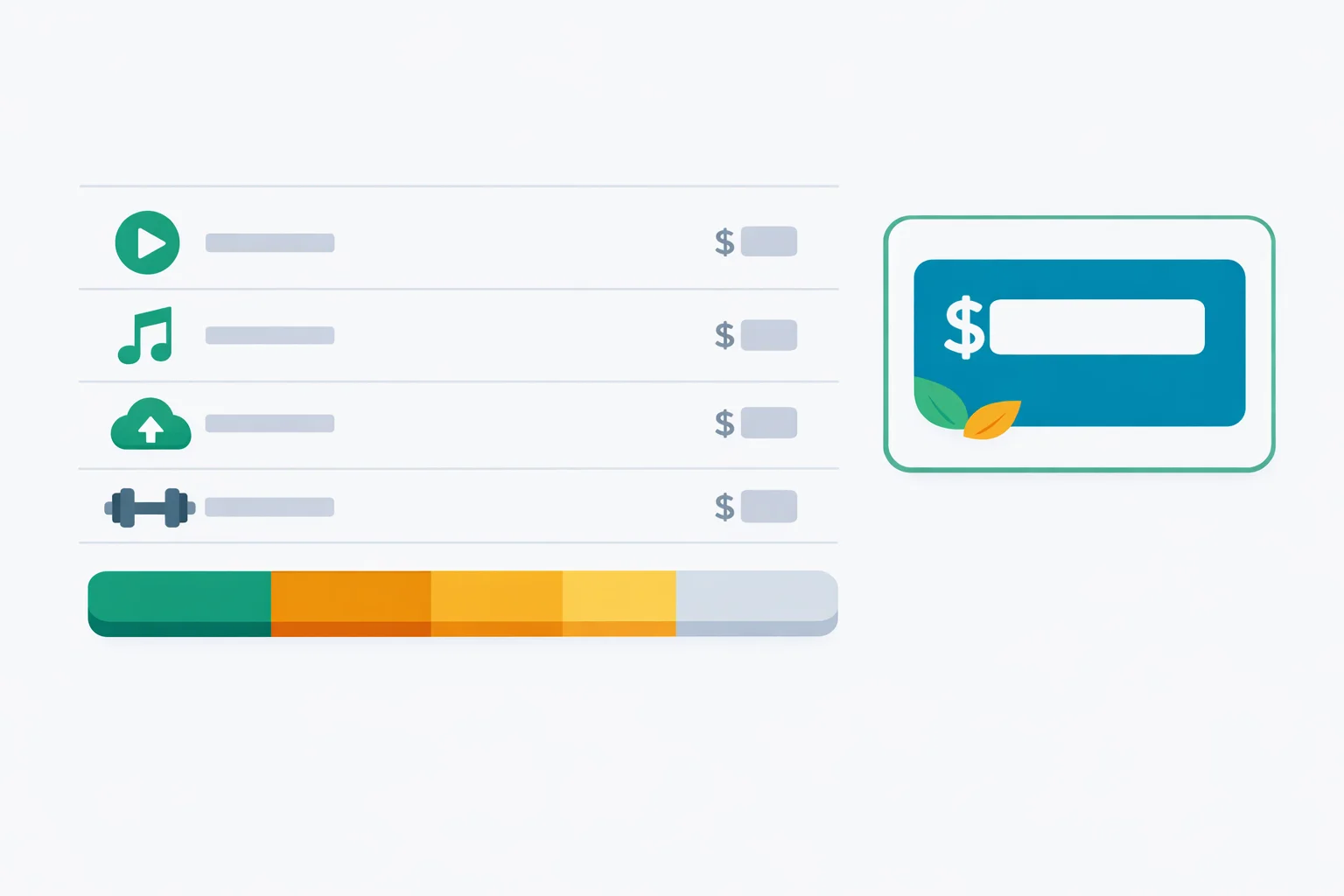
A subscription cost calculator exists because nobody feels $16.99. You feel $1,522 — but that number never appears on a statement. It arrives in eight separate pieces, on eight different days of the month, from eight different merchants, and your brain files each one under "small." The stack below is a completely ordinary one: two streaming services you actually watch, two you don't, a gym, a music app, cloud storage, and an office suite. Annualized, it costs more than most people's car insurance.
What follows is the audit method the calculator above runs: normalize every billing cycle to a monthly figure, divide by how often you actually use the thing, and then decide. The cost-per-use step is what makes it work. It converts a subjective argument ("but I like having it") into a price you can compare against buying the same thing à la carte.
Mixed cycles, one number
Weekly, quarterly and annual charges are converted to a true monthly cost so nothing hides.
Cost per use, ranked
Anything above $5 per session gets flagged. That threshold is roughly what a single movie rental costs.
The 10-year price tag
Every cancellation is priced as an investment, so you can see what the money does instead.
Why the Monthly Number Always Understates It
Subscriptions bill on four common rhythms, and only one of them is monthly. To compare them you convert everything to a monthly equivalent:
The 4.333 matters more than it looks. A $4.99 weekly charge feels cheaper than a $19.99 monthly one, but it bills 52 times a year, not 48 — that's $259.48 annually versus $239.88. Weekly billing quietly adds a thirteenth month.
Annual charges cause the opposite distortion. Amazon Prime at $139 a year is $11.58 a month — more than your cloud storage and office suite combined ($11.32) — yet it never appears in a monthly review. This is the charge people forget when they build a monthly household budget — the annual renewals sit outside the mental model until the card gets declined.
Cost Per Use: The Only Number That Settles the Argument
The formula is one line, and it changes conversations:
Max at $16.99 a month, opened once, costs $16.99 per session. A single movie rental is $3.99 and a three-month pass on the same service is often cheaper than four months of continuous billing. Spotify at $11.99 used 26 times a month costs $0.46 a session — less than a coffee refill. Both are "a streaming subscription." They are not remotely the same purchase.
Use this threshold: $5 per use. Below it, the subscription is doing its job. Above it, you're paying a convenience premium for something you could buy individually and still come out ahead.
Auditing a Real $1,522 Stack
Here is the default stack from the calculator, normalized and ranked. The usage counts are the honest kind — the number of times you actually opened the app last month, not the number you intended to.
| Service | Billed | Monthly | Annual | Uses/mo | Cost per use |
|---|---|---|---|---|---|
| Gym membership | $45.00/mo | $45.00 | $540.00 | 5 | $9.00 |
| Netflix (Standard) | $17.99/mo | $17.99 | $215.88 | 12 | $1.50 |
| Max (ad-free) | $16.99/mo | $16.99 | $203.88 | 1 | $16.99 |
| Spotify Premium | $11.99/mo | $11.99 | $143.88 | 26 | $0.46 |
| Disney+ | $11.99/mo | $11.99 | $143.88 | 2 | $6.00 |
| Amazon Prime | $139/yr | $11.58 | $139.00 | 9 | $1.29 |
| Microsoft 365 Personal | $99.99/yr | $8.33 | $99.99 | 8 | $1.04 |
| iCloud+ 200GB | $2.99/mo | $2.99 | $35.88 | 30 | $0.10 |
| Total | — | $126.87 | $1,522.39 | 93 | $1.36 avg |
Three services clear the $5 threshold — Max, the gym, and Disney+ — and together they cost $887.76 a year, or 58% of the total bill for 8 of the 93 monthly uses. The other five services deliver 85 uses for $634.63.
Cancelling just Max and Disney+ frees $28.98 a month. Put that into an index fund at 7% and it compounds to $5,016 in ten years ($3,478 contributed, $1,538 growth) and $35,353 over thirty years. The exact math is the same annuity formula our compound interest calculator uses — the only unusual thing here is that the deposit is funded by two shows you weren't watching.
Should You Prepay for the Year?
Most services discount 15–20% for annual prepay, usually framed as "two months free." That's real money, but the discount only pays off if you stay past the break-even month:
| Plan | Monthly billing | Annual prepay | You save | Break-even |
|---|---|---|---|---|
| $9.99/mo service | $119.88/yr | $99.99 | $19.89 (17%) | Month 10.0 |
| $17.99/mo service | $215.88/yr | $179.99 | $35.89 (17%) | Month 10.0 |
| $45/mo gym | $540.00/yr | $450.00 | $90.00 (17%) | Month 10.0 |
The pattern is consistent: a "two months free" deal breaks even in month 10. Cancel in month 6 and you've paid $179.99 for what monthly billing would have cost $107.94 — a $72 loss on a discount you took to save money. Gyms are the worst offender here, because January prepays and March attendance don't match.
Prepay the boring infrastructure — cloud storage, password managers, the office suite you've used for five straight years. Stay monthly on anything entertainment-shaped, where your interest genuinely fluctuates.
Streaming Prices Rose Faster Than Almost Anything Else You Buy
The reason your subscription total keeps climbing without you adding services is that the services keep repricing. Approximate US list prices for a common five-service basket:
| Service (entry plan) | ~2020 | ~2026 | Change |
|---|---|---|---|
| Hulu (ad-supported) | $5.99 | $11.99 | +100% |
| Disney+ | $6.99 | $11.99 | +72% |
| Netflix Standard | $12.99 | $17.99 | +38% |
| Spotify Premium | $9.99 | $11.99 | +20% |
| YouTube Premium | $11.99 | $13.99 | +17% |
| Basket total | $47.95/mo | $67.95/mo | +42% |
Over the same six years, general consumer prices rose roughly 26% according to the Bureau of Labor Statistics CPI. That basket outran inflation by about 16 percentage points — $240 a year in extra cost for the identical service list. Plan names and tiers shifted repeatedly during that window, so treat these as directional and check your own statement; the trend, not the decimal, is the point.
This is why an annual re-audit beats a one-time cleanup. Nothing on your list gets cheaper on its own, and most price increases arrive as an emailed notice you never opened.
Where the Money Actually Leaks
Trials that convert while you're not looking
A 7-day trial on a $16.99 service that you notice eight months later costs $135.92. Two of those a year is more than your entire cloud storage bill for a decade.
Paying for the same service twice
Signing up on the web after an earlier App Store or Google Play signup produces two live billings for one login. On a $14.99 service, that's $179.88 a year for nothing — and it rarely shows up as a duplicate on your statement, because the merchant names differ.
Individual plans where a family plan exists
Six individual music accounts at $11.99 cost $863.28 a year. One family plan at $19.99 covering all six costs $239.88. That's $623.40 saved for a five-minute setup, and the same math applies to cloud storage and password managers.
Cancelling an annual plan in month three
Most annual plans are non-refundable. Cancelling a $179.99 prepay after three months means you consumed $53.97 of value and forfeited $126.02 — and you still lose access at renewal, not immediately.
Cancel, Downgrade, or Keep?
Run every line through this once and the decisions take about fifteen minutes total:
Under $1 per use → Keep
iCloud at $0.10 and Spotify at $0.46 are the cheapest entertainment you buy. Cancelling these to save $14.98 a month while a $16.99 line item sits unused is the wrong end of the list.
$1–$5 per use → Downgrade
Drop to the ad-supported tier (typically 35–55% cheaper), step down a storage or resolution tier, or split a family plan. Netflix at $1.50 a use doesn't need cancelling — it needs a $7.99 ad tier, which cuts cost per use to $0.67.
Over $5 per use → Cancel
Buy it à la carte instead. Max at $16.99 for one film loses to four $3.99 rentals. Resubscribe for one month when a season you want actually drops — that's $16.99 instead of $203.88.
Feed the resulting monthly savings straight into a target rather than back into general spending — otherwise it evaporates within two pay cycles. Assigning it to a specific number in a savings goal calculator or slotting it into the savings bucket of the 50/30/20 budget rule is what turns a cancellation into an actual balance.
When Cancelling Costs You More Than Keeping
Cost per use is a good referee, not a verdict. Four situations where the high number is fine:
- Grandfathered pricing.If you're on a legacy plan the provider no longer sells, cancelling is permanent. Resubscribing at current list can cost 40–70% more, which wipes out several years of savings.
- Tools that generate income. A $99/year design or accounting tool that supports $6,000 of freelance revenue is a 1.7% cost of goods, not a luxury. Cost per use is the wrong metric — revenue per dollar of tool is.
- Bundles where one leg subsidizes another. Dropping the phone line or the internet plan that carries a bundled streaming credit can raise the remaining bill by more than the service cost. Price the whole bundle before pulling one thread.
- Insurance-shaped services.A gym at $9 per visit still beats one physical-therapy course of treatment. Same logic for identity monitoring or a cloud backup you've never restored from — the payoff is a tail event, not a monthly session count.
One more: don't cancel your way into a cash-flow illusion. If the freed-up $80 a month gets absorbed by ordinary spending, you've traded services for nothing. Compare the number against your actual monthly surplus using an expense calculator before you decide the audit "worked."
Do You Need a Tracking App for This?
The subscription-cancellation apps advertise themselves as free and then charge $8 to $15 a month, or take a cut of whatever they cancel on your behalf — typically 33 to 40% of the first year's savings. On the $887.76 of low-value services in the audit above, a 35% cut is $310 handed over for cancellations you could make in an afternoon. That's a negative return on an audit whose entire point is eliminating recurring fees.
The other cost is access. Most of these services require read permission on your bank account through an aggregator, which means your full transaction history leaves your bank to sit on a third party's servers. A subscription cost calculator that runs entirely in your browser asks for none of that — nothing you type here is transmitted or stored, and the CSV export stays on your machine.
There is one job the apps do well: catching charges you genuinely forgot. If you'd rather not scan statements manually, use a free trial for a single month to generate the list, cancel the app itself, and then run the numbers here. You get the discovery without the recurring fee — which is, fittingly, the same logic the rest of this audit runs on.
The 30-Day Cancellation Sequence
Day 1 — Pull three sources, not one.Card statement, bank statement, and both app store subscription pages (iOS: Settings → your name → Subscriptions; Android: Play Store → Payments & subscriptions). App-store billing is where forgotten charges hide, because it appears on your card as a single lumped payment.
Day 2 — Scan back 13 months. Twelve months catches every monthly charge; the thirteenth catches annual renewals that fall just outside the window.
Day 3 — Cancel the obvious zeros immediately. Anything with zero uses last month goes today. In most US states, including California under its automatic renewal law, a service you signed up for online has to let you cancel online — you should not need a phone call.
Days 4–30 — Run a use log on the borderline ones.Note every time you open the $1–$5 services. Real counts almost always come in below the estimate, which resolves the arguments you couldn't settle on day 1.
Day 30 — Automate the redirect and set a recurring audit. Move the freed amount to a separate account on payday, and put a 12-month reminder on the calendar. Prices will have moved again by then.
A practical starting move: rotate rather than stack. Netflix, Max, Disney+ and Hulu together run $58.96 a month, or $707.52 a year. Subscribe to one at a time and switch quarterly and you still get all four across the year — for about $177. You also finish shows instead of collecting them.