Turning a Treasury Auction Quote Into Real Dollars
A Treasury bond calculator turns a confusing auction quote — a discount rate here, a coupon there, a yield to maturity somewhere else — into the one number you actually care about: how much you’ll earn. Say you have $10,000 sitting in cash and you’re deciding between a 26-week Treasury bill, a 10-year note, and a 30-year bond. They’re all backed by the same government, but they pay you in completely different ways, carry wildly different risk, and hand you a state-tax break most investors forget to count. This page shows the math behind each one, with real numbers you can check.
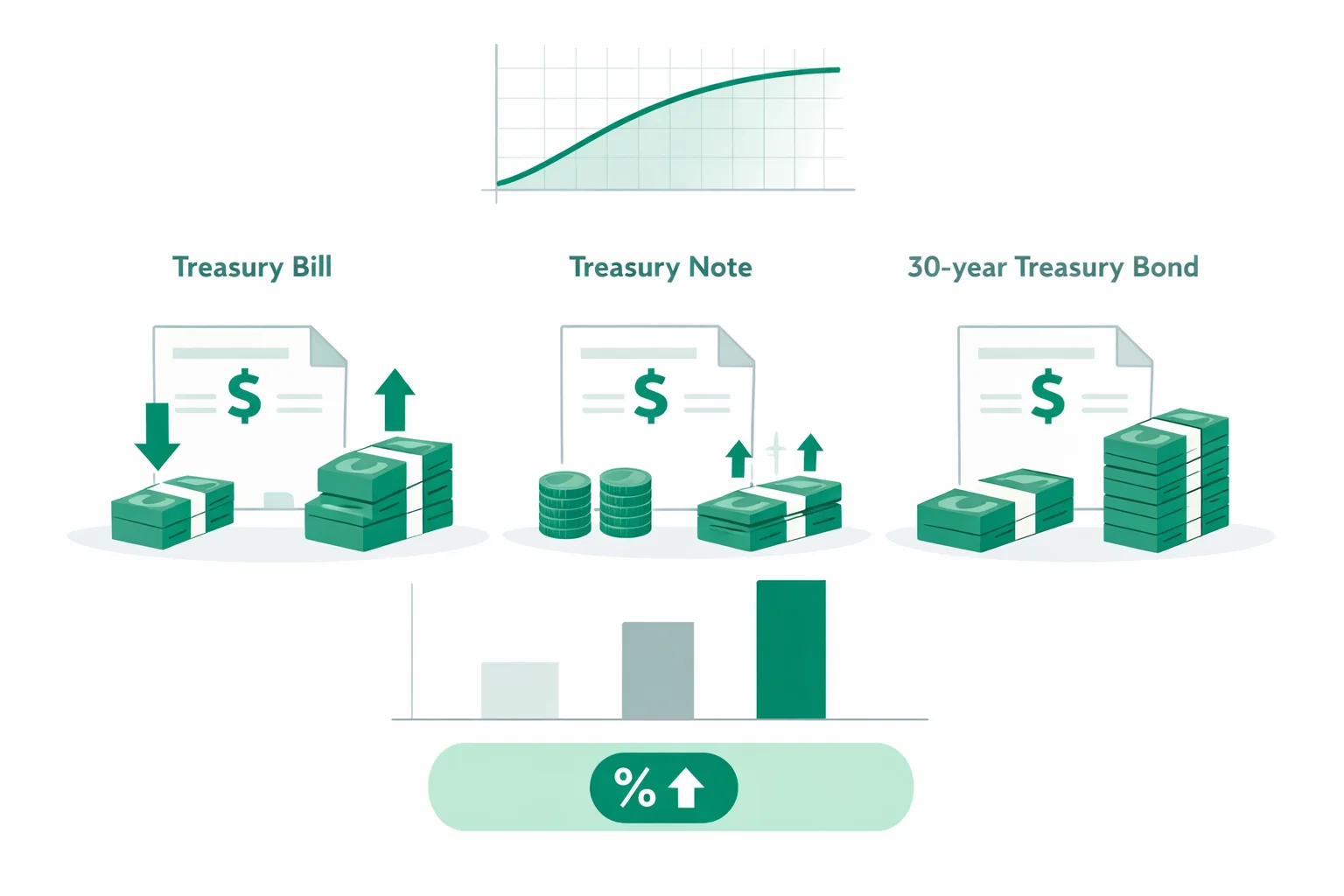
T-Bills
4 to 52 weeks. No coupon — you buy below $1,000 and get the full $1,000 back. All return is the discount.
T-Notes
2 to 10 years. A fixed coupon lands in your account every six months, then principal returns at maturity.
T-Bonds
20 or 30 years. The longest coupons, the highest yields — and by far the most price swing when rates move.
Bills, Notes, and Bonds: Same Lender, Three Different Bets
Every one of these is a loan to the U.S. Treasury, and the only real difference is how long you lend and how you get paid. The naming trips people up because “Treasury bond” gets used loosely for all of them, but the Treasury draws hard lines by maturity. Here’s the full menu of what actually gets auctioned:
| Security | Maturities | How it pays | Interest paid |
|---|---|---|---|
| Treasury Bill | 4, 8, 13, 17, 26, 52 weeks | Bought at a discount | Lump sum at maturity |
| Treasury Note | 2, 3, 5, 7, 10 years | Fixed coupon | Every 6 months |
| Treasury Bond | 20, 30 years | Fixed coupon | Every 6 months |
| TIPS | 5, 10, 30 years | Coupon + inflation adjustment | Every 6 months |
The calculator above handles bills, notes, and bonds — the three you’ll auction most often. Pick a type at the top and the inputs change to match how that security actually works.
How a T-Bill Actually Pays You
A bill never pays a coupon. You buy it below face value and collect the full face at maturity, and the gap is your entire return. Treasury quotes bills using a “bank discount rate,” which understates your true yield — so the calculator converts it for you. The pricing formula is:
Run a 26-week bill (182 days) at a 4.15% discount rate on a $10,000 face value:
- Price = $10,000 × (1 − 0.0415 × 182 ÷ 360) = $9,790.19
- Return = $10,000 − $9,790.19 = $209.81
- Investment (coupon-equivalent) yield = ($209.81 ÷ $9,790.19) × (365 ÷ 182) = 4.30%
Notice the true yield (4.30%) is higher than the quoted discount rate (4.15%). That’s because the discount convention divides by face value and uses a 360-day year, while your money is actually tied up against the lower purchase price for 365 days. Comparing a bill’s quoted rate to a bank CD’s annual percentage yield is apples to oranges — convert both to the same basis first, the same way an APY calculator normalizes compounding on a savings account.
Pricing a Note or Bond When Rates Move
Notes and bonds are priced by discounting every future cash flow — each semi-annual coupon plus the final principal — back to today at the current market yield. When the market yield sits above the coupon rate, the bond trades at a discount; below it, a premium. The engine is present value:
Take a 10-year note with a $10,000 face value and a 4.25% coupon (so $212.50 every six months, 20 payments in all) when the market yield is 4.40%. Discounting all 20 coupons plus the $10,000 principal at 2.20% per half-year gives a price of about $9,880— a small discount, because you’re buying a 4.25% coupon in a 4.40% world. Hold it to maturity and you collect $4,250 in coupons plus a $120 pull-to-par gain, for a total return near $4,370. If you want to see how that price reacts to different coupon-versus-yield combinations, the bond price calculator walks through the discounting cash flow by cash flow.
The Tax Break Nobody Puts on the Brochure
Here’s the part of Treasuries that quietly beats a CD: the interest is fully taxable by the federal government but completely exempt from state and local income tax. A bank CD or corporate bond paying the same rate gets taxed by both. In a high-tax state, that exemption is worth real money. On a $10,000, 4.40% note, the $440 of annual interest escapes a 6% state tax — saving you about $26 a year. That sounds small until you scale it: on a $250,000 Treasury ladder, the state exemption is worth roughly $660 a year, every year.
The cleaner way to see it is the taxable-equivalent yield. A state-taxable CD has to out-yield the Treasury to leave you the same after-tax income:
At a 6% state rate, a 4.40% Treasury matches a 4.68%CD. In California’s 9.3% top bracket, that same Treasury matches a 4.85% CD. This is the mirror image of how tax-free municipal bonds work, and if you’re also weighing munis, run the numbers through the tax-equivalent yield calculator so all three — Treasury, muni, and corporate — sit on one honest after-tax scale.
Rule of thumb:in a no-income-tax state (Texas, Florida, Washington), the Treasury tax edge disappears — compare gross yields directly. The higher your state rate, the more a Treasury pulls ahead of a same-yield CD.
Bill vs Note vs Bond vs CD, Side by Side
The right choice depends on how long you can lock up the money and how much price swing you can stomach. Here’s how the four options stack up on the dimensions that matter:
| Feature | T-Bill | T-Note / T-Bond | Bank CD |
|---|---|---|---|
| State tax | Exempt | Exempt | Fully taxable |
| Price risk if you sell early | Tiny | Low to very high | None (early-withdrawal penalty) |
| Pays interest | At maturity | Every 6 months | Varies |
| Default risk | Effectively zero | Effectively zero | FDIC to $250k |
| Best for | Parking cash 1–12 months | Locking a yield for years | Simplicity, insured savings |
What Happens to a 30-Year Bond If Rates Jump?
This is the risk that surprises new bond buyers. A Treasury held to maturity always returns face value, but its price in the meantime moves opposite to rates — and the longer the maturity, the harder it swings. Buy a 30-year bond at a 4.5% yield and watch rates climb one point to 5.5%: the bond’s market price drops roughly 15%, about $1,500 on a $10,000 position. The same one-point jump barely scratches a 26-week bill, because it matures before rates matter. That’s the trade-off — the long bond’s higher yield comes with the wildest price ride if you ever need to sell.
The flip side is just as real: if rates falla point, that 30-year bond jumps in value by a similar amount, which is why investors reach for long bonds when they expect rates to drop. If you plan to hold to maturity and just want the income, the price swings are noise — you get your coupons and your principal regardless.
Common Mistakes That Cost Real Money
Comparing a bill’s discount rate to a CD’s APY.The discount rate understates your real yield — a 4.15% bill actually yields about 4.30%. Judge a bill on its investment yield, or you’ll wave off a Treasury that quietly beats the CD.
Forgetting the state-tax exemption.Investors in high-tax states pick a CD that’s “0.2% higher” and lose money after tax. On $250,000 at a 9.3% state rate, that exemption is worth over $1,000 a year — often more than the yield gap you were chasing.
Buying a 30-year bond for a 3-year goal.If rates rise before you sell, you can lose 10% to 20% of principal on a long bond. Match the maturity to when you actually need the cash — a bill or short note for near-term money.
When a Treasury Is the Wrong Choice
Treasuries are the safest bond on earth, but safe isn’t the same as always right. Skip them when:
- You need long-term growth, not income.A 4.5% Treasury won’t keep pace with a diversified stock portfolio over 20 years — model that gap with an investment calculator before you lock in a low fixed yield.
- You’re in a no-tax state and a CD yields more. Without the state-tax edge, a higher-paying insured CD can simply win.
- You want inflation protection. A fixed coupon loses purchasing power if inflation spikes; TIPS or I bonds fit better there.
- The money is inside a 401(k) or IRA. The state-tax exemption is wasted in an account that’s already tax-deferred.
Choose Bills, Notes, or Bonds
Pick a bill if…
- You need the cash within a year
- You want near-zero price risk
- You’re parking an emergency fund
Pick a note if…
- You want to lock a yield for 2–10 years
- You like steady semi-annual income
- You can ride out modest price swings
Pick a bond if…
- You’re funding a 20–30 year goal
- You want the highest fixed yield
- You expect rates to fall
Where to Buy and How Yields Get Set
You can buy any of these straight from the government at TreasuryDirect with no commission, or through a brokerage. At auction, the yield isn’t fixed in advance — it’s set by competitive bidding, and everyone pays the same high-yield rate that clears the auction. That’s why the coupon on a new note rarely matches the market yield to the basis point, and why almost every Treasury trades at a slight premium or discount the moment it hits the secondary market. Plug the coupon and the current market yield into the calculator to see exactly what that gap does to your price.